economy and refugees by hiring Ukrainian Software Developers - we donate a lot to charities and volunteer foundations


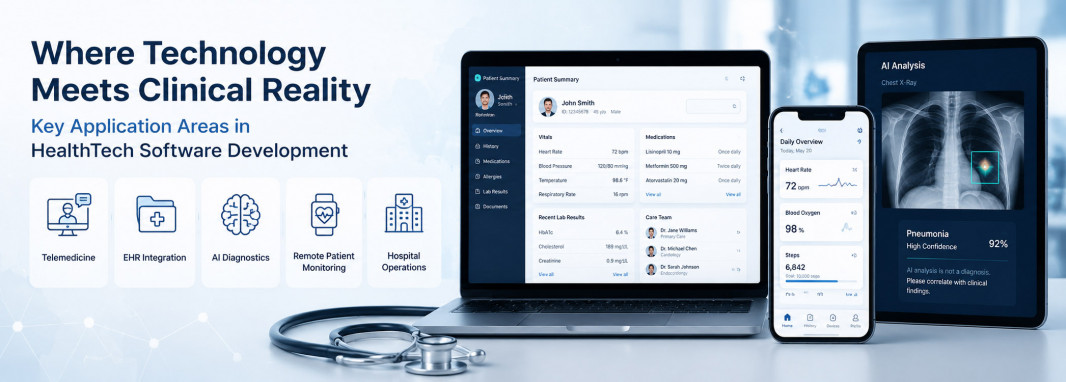
Digital health is not a single market. It is a collection of distinct clinical and operational domains, each with its own regulatory requirements, integration constraints, and technology stack considerations. For business leaders evaluating where and how to build, understanding these domains – and the technical complexity each carries – is the foundation of a sound product strategy.
This article examines the primary application areas where HealthTech software creates measurable value, and the technical realities that determine whether that value is actually delivered.
Telemedicine and Virtual Care Platforms
Telemedicine experienced a structural shift during the COVID-19 period and the change in utilization patterns has largely held. The technology is no longer experimental – it is becoming standard infrastructure for primary care, chronic disease management, and specialist consultation.
The technical requirements for a production-grade telemedicine platform go well beyond video calls:
- WebRTC-based video infrastructure with failover and adaptive bitrate for variable clinical environments
- Asynchronous communication workflows for store-and-forward use cases (dermatology, radiology, pathology)
- Integrated clinical documentation within the consultation flow – not as a separate step
- EHR write-back: consultation notes, prescriptions, and referrals need to land in the patient's primary record
The last point is where most telemedicine platforms underdeliver. A consultation that doesn't propagate to the patient's EHR creates a documentation gap that clinicians then have to close manually – which is precisely the workflow friction that drives clinician resistance to new tools.
Zfort Group has built telemedicine infrastructure with direct HL7/FHIR write-back to major EHR platforms, reducing post-consultation documentation time and increasing clinician adoption rates.
EHR Integration and Health Data Interoperability
Electronic Health Record integration is consistently cited as one of the most technically complex and time-consuming aspects of HealthTech development. The reason is structural: EHR systems were not designed for interoperability. They were designed for documentation within a single clinical environment.
HL7 FHIR (Fast Healthcare Interoperability Resources) is the current standard for health data exchange, and it represents genuine progress. But 'FHIR-compliant' covers a wide range of actual implementation quality. The specification allows significant variation in how data is structured and what fields are populated.
In practice, integrating with a hospital's EHR via FHIR involves:
- Negotiating sandbox access – a process that typically takes four to eight weeks with enterprise health systems
- Mapping data models between the FHIR specification and the specific implementation used by the target EHR
- Handling missing, null, or inconsistently formatted data in production records
- Managing version differences between FHIR R4 and DSTU2 implementations still in production at some health systems
Teams that have not built FHIR integrations before consistently underestimate this work by a factor of two to three. The technical complexity is not in the API calls – it is in the edge cases in real clinical data.
AI-Assisted Diagnostics and Clinical Decision Support
Artificial intelligence in clinical settings is no longer a research prototype category. Deployed AI tools exist across radiology, pathology, cardiology, and primary care – and the regulatory framework for these tools has matured accordingly.
The FDA's framework for AI/ML-based Software as a Medical Device establishes a risk-based classification approach. Tools that inform clinical decisions carry different regulatory burdens than tools that automate them. Understanding this distinction before beginning model development is not optional – it determines the validation requirements, the deployment architecture, and the timeline to market.
Key technical considerations for AI in clinical environments:
- Model explainability: clinicians require understanding of why a model produced a given output, not just what it produced. Black-box outputs are not acceptable in clinical review processes
- Prospective validation: models validated on historical datasets require prospective clinical validation before deployment in live care settings
- Data pipeline integrity: AI models are only as reliable as the data they receive. Image quality variation, DICOM format inconsistencies, and EHR data completeness issues all affect model performance in production
- Drift monitoring: clinical AI models require ongoing performance monitoring, as patient population shifts and clinical workflow changes affect output quality over time
Zfort Group has implemented AI-assisted diagnostic tools with integrated explainability layers and monitoring pipelines – built to meet both the clinical review requirements of healthcare organizations and the regulatory expectations of the FDA's evolving guidance.
Patient Engagement and Remote Patient Monitoring
Patient-facing applications sit at the intersection of consumer product design and clinical compliance requirements – a combination that creates distinctive engineering challenges.
Remote Patient Monitoring (RPM) platforms that collect physiological data from wearable devices and transmit it to clinical teams require:
- Device integration: Bluetooth Low Energy (BLE) connectivity, proprietary device SDKs, and data normalization across device types
- Real-time alerting infrastructure: thresholds for clinical intervention need to trigger reliably, with low-latency notification delivery
- Patient-facing UX designed for populations with variable digital literacy and chronic disease burden – not for early adopters
- Clinical workflow integration: data collected from patients must reach the right clinician, in the right format, at the right time
The commercial opportunity in RPM is significant – CMS reimbursement codes for remote monitoring services have expanded the business case for these tools substantially. But the reimbursement model requires documentation of clinical touchpoints that the software must generate and retain.
Hospital Operations and Healthcare Administration Software
The administrative layer of healthcare – scheduling, billing, resource allocation, supply chain – represents a large and underserved software opportunity. Clinical environments run on a combination of legacy systems, manual processes, and point solutions that don't communicate with each other.
The integration complexity in hospital operations software often exceeds that of clinical tools, because the data flows connect more systems: EHR, billing, pharmacy, laboratory, radiology, HR, and supply chain. Each of these systems has its own data model and integration interface.
What makes this domain commercially attractive for software companies is the measurable operational impact. Scheduling optimization, bed management, and staff allocation tools have direct, quantifiable effects on hospital revenue and cost – which makes the ROI case for buyers straightforward.
Zfort Group has delivered hospital operations software that integrates across clinical and administrative systems, with real-time dashboards that give operational leadership visibility into capacity, throughput, and resource utilization.
What This Means for Your Technology Strategy
The application areas above share a common thread: the technical complexity is not primarily in the core functionality. It is in the integration, the compliance architecture, and the clinical workflow fit.
For business leaders evaluating these domains, the implication is that technology partner selection is a strategic decision, not a procurement exercise. The team building your platform needs to have resolved the hard integration problems before – not be resolving them for the first time on your timeline and your budget.
The right questions to ask are specific: Which EHR systems have you integrated with in production? How have you handled FHIR data quality issues at scale? What does your HIPAA compliance architecture look like, and how do you validate it?
The answers to those questions are more predictive of project outcome than any portfolio or case study.