economy and refugees by hiring Ukrainian Software Developers - we donate a lot to charities and volunteer foundations

The global digital health market reached approximately $288 billion in 2024 and is projected to approach $950 billion by 2030 — growing at a CAGR of 23.6%. But behind those numbers lies a more complicated reality: a significant share of HealthTech software projects fail to reach clinical adoption — not because the technology was wrong, but because the business and delivery model was.
This article is for founders, product leaders, and healthcare executives who are either building digital health software for the first time or scaling what they've already launched. The goal is not to cover every technical detail, but to surface the decisions that determine whether a project succeeds or stalls.
Why HealthTech Is a Different Business Category
Most software markets reward speed to market. In healthcare, speed without compliance discipline creates liability, not advantage.
The regulatory environment is the first filter. In the United States, any software that qualifies as a Software as a Medical Device (SaMD) under FDA guidance, or any platform that stores, transmits, or processes protected health information (PHI), is subject to HIPAA's administrative, physical, and technical safeguard requirements. In the EU, the Medical Device Regulation (MDR) sets the framework. Violating either carries penalties that are not recoverable at the Series A stage.
This doesn't mean moving slowly. It means building compliance into the architecture from the start — not as a legal checkbox, but as an engineering discipline.
The Real Cost of Getting It Wrong Early
The most expensive mistake in HealthTech development is treating regulatory and security requirements as a final phase. Teams that defer HIPAA compliance or security architecture until late in the build cycle routinely face:
- Complete rearchitecting of data storage and access control layers
- Audit trail retrofitting — technically difficult and often incomplete
- Delayed go-to-market while compliance reviews catch up to the codebase
- Loss of early enterprise contracts where compliance documentation is a procurement requirement
At Zfort Group, we've inherited projects where security was treated as an afterthought. The pattern is consistent: the rework costs more than the original build, and the timeline impact is rarely recoverable within the original fundraising runway.
What Clinical Buyers Actually Evaluate
Enterprise healthcare buyers — hospital systems, payer networks, large physician groups — have procurement processes that differ substantially from those in other verticals. The evaluation criteria that matter:
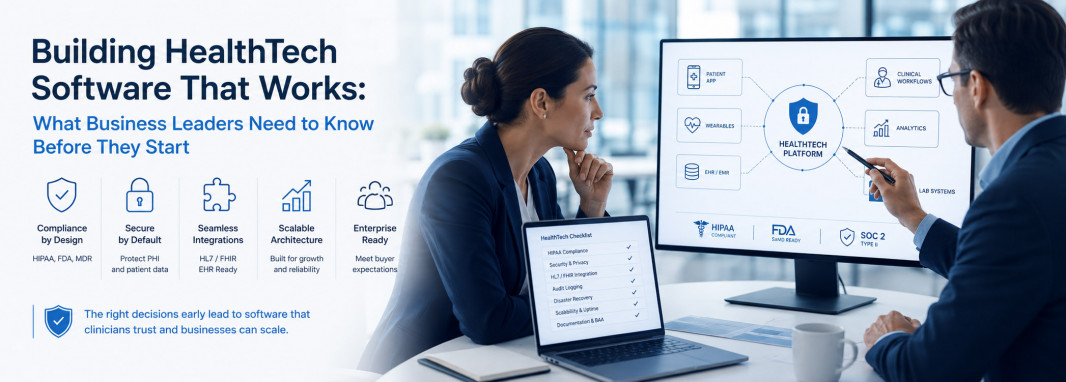
- Security posture documentation: SOC 2 Type II, HIPAA Business Associate Agreements (BAA), penetration testing records
- Integration capability: Can the platform connect with existing EHR infrastructure via HL7/FHIR, or does it require bespoke middleware?
- Uptime and disaster recovery SLAs: Clinical environments have defined availability requirements
- Data residency and sovereignty: Increasingly relevant for cross-border deployments and EU-based health systems
Startups that enter enterprise sales conversations without this documentation ready lose deals to competitors who do — regardless of feature parity.
Platform Architecture: The Strategic Decisions That Compound
Three architectural decisions made at the start of a HealthTech project have compounding consequences:
First: data model design. How patient data is structured determines the complexity of every downstream integration, every analytics layer, and every regulatory audit. Getting this wrong is expensive to reverse.
Second: identity and access management. Role-based access control (RBAC) in clinical environments is non-trivial. A nurse, a physician, a billing administrator, and a patient all have different access rights to the same record. Systems that don't model this correctly create both security gaps and workflow friction.
Third: audit logging. HIPAA requires the ability to demonstrate who accessed what data, when, and from where. Systems that don't log at the right granularity from day one cannot be made compliant retroactively without significant re-engineering.
Zfort Group approaches these decisions as foundational architecture choices — not features to be added later. Our HealthTech engagements begin with a compliance and architecture review before any product code is written.
The Partnership Model That Actually Works
The most successful HealthTech builds we've been part of share a common characteristic: the client brought in an engineering partner early, not after the initial architecture was already set.
The reason is straightforward. Decisions made in the first four to six weeks of a HealthTech project — data model, compliance architecture, integration strategy — are difficult and expensive to reverse. Bringing in a development partner after those decisions are made means inheriting their constraints.
For founders and product leaders evaluating development partners for HealthTech projects, the questions that matter are not about general capability. They are about specific experience: Has this team built HIPAA-compliant systems before? Have they handled HL7/FHIR integrations in production? Do they understand the difference between clinical-grade reliability and standard SaaS uptime?
The answers to those questions determine whether a partnership accelerates your roadmap or adds to it. If you're evaluating a technology partner for your next digital health initiative, we're open to a conversation.