economy and refugees by hiring Ukrainian Software Developers - we donate a lot to charities and volunteer foundations


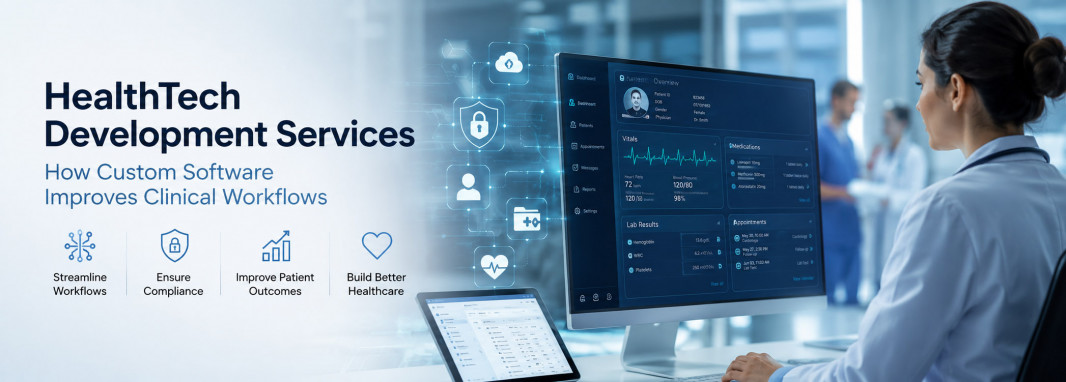
Healthcare organizations are under constant pressure to do more with less. Clinical teams are expected to deliver better patient outcomes, administrative staff are asked to move faster with fewer errors, and leadership teams are balancing growth, compliance, security, and operational efficiency at the same time. Meanwhile, many providers still rely on fragmented systems, outdated workflows, disconnected data, and software that was never designed for modern care delivery.
This is where HealthTech development services create measurable business value.
Custom healthcare software is no longer limited to large hospital systems with enterprise budgets. Clinics, digital health startups, telehealth providers, multi-location healthcare groups, specialty practices, and healthcare technology companies increasingly invest in purpose-built software that solves operational bottlenecks, improves patient engagement, and supports clinical decision-making.
Instead of forcing teams to adapt to generic software, custom HealthTech solutions are designed around actual workflows, compliance requirements, integration realities, and long-term growth plans.
Whether the goal is connecting disconnected systems, reducing manual administrative work, improving digital patient experiences, modernizing legacy infrastructure, or building entirely new digital health products, the right development strategy can significantly improve how healthcare organizations operate.
In this guide, we explore what HealthTech development services include, which business problems they solve, what types of platforms organizations build, and how custom software improves clinical workflows across modern healthcare environments.
What Are HealthTech Development Services?
HealthTech development services refer to the design, engineering, integration, deployment, and ongoing support of software solutions built specifically for healthcare organizations and digital health businesses.
This includes far more than simply building a mobile healthcare app. Modern HealthTech development typically covers:

Custom healthcare software platforms
EHR and EMR system development & modernization
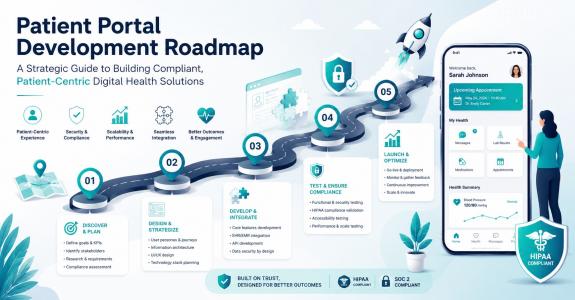
Patient portals and engagement hubs
Telehealth and virtual care applications
Remote Patient Monitoring (RPM) systems
Healthcare analytics and population health platforms
Medical billing and Revenue Cycle Management (RCM) automation tools
Clinical workflow automation systems
Healthcare interoperability solutions (HL7, FHIR, DICOM)
Healthcare CRM systems
AI-powered clinical and administrative tools
Compliance-focused data management platforms
Digital health SaaS products
The difference between healthcare software development and generic software development is context. Healthcare systems operate within highly specialized environments where operational complexity, compliance requirements, patient safety, security standards, and interoperability challenges directly affect both business outcomes and care delivery.
A generic development team may know how to build software. A capable HealthTech development team understands:
Healthcare workflow dependencies: How data moves from triage to treatment and billing.
Protected Health Information (PHI) handling: Technical requirements for processing sensitive data securely.
Secure access models: Role-Based Access Control (RBAC) for doctors, nurses, and admins.
Audit logging requirements: Strict tracking of who accessed what data and when.
Clinical documentation workflows: Reducing the time clinicians spend on data entry.
Integration constraints: Working with rigid legacy systems and strict interface engine rules.
Provider-side operational realities: Avoiding software that causes "alarm fatigue" or interface clutter.
Digital patient experience expectations: Creating intuitive interfaces for diverse age groups and technical backgrounds.
This domain understanding matters because poor technical decisions in healthcare create operational friction, compliance exposure, and user adoption failures.
Common Clinical Workflow Problems Custom Software Solves

Many healthcare organizations do not initially search for software. They search for solutions to operational pain. The most valuable HealthTech software initiatives start with real workflow bottlenecks.
1. Disconnected Healthcare Systems (The Fragmentation Trap)
One of the most common operational challenges in healthcare is fragmentation. A provider may use an EHR, separate billing software, scheduling software, telehealth tools, CRM platforms, lab systems, and document storage tools simultaneously. When each system functions independently, it creates duplicated work, inconsistent patient records, delayed communication, reporting blind spots, and staff frustration.
The Pain: Reception teams manually enter patient information multiple times into different systems; billing teams manually reconcile data across separate platforms; providers constantly switch between multiple windows during patient interactions.
The Custom Solution: Custom HealthTech development solves this by creating an integrated ecosystem. By building custom API layers or middleware, all specialized software communicates in real time, establishing a single source of truth for patient data.
2. Administrative Overload and Burnout
Healthcare staff lose substantial time to repetitive administrative tasks such as manual appointment confirmations, repetitive documentation entry, insurance eligibility verification, billing corrections, claims follow-up, and patient intake coordination.
The Pain: High administrative overhead scales up operational costs linearly—meaning to grow, a clinic must hire more and more back-office staff.
The Custom Solution: Automated workflow rules can verify insurance eligibility instantly before the patient arrives, send automated, conversational follow-ups, and flag billing errors before submission. This reduces error rates, patient delays, and operational friction.
3. Slow Clinical Documentation
Documentation remains a major source of operational inefficiency and provider burnout. Clinicians spend significant portions of their day entering notes, reviewing fragmented records, updating forms, and managing compliance documentation instead of focusing on direct patient care.
The Pain: Decreased provider productivity, longer patient wait times, and a drop in overall patient throughput.
The Custom Solution: Modern HealthTech platforms streamline this via structured, intuitive data entry, integrated document systems, smart form logic that auto-populates known data, and Ambient Clinical Intelligence (AI-driven voice-to-text tools that draft clinical notes during patient interactions).
4. Poor Patient Experience
Patients increasingly expect healthcare experiences that feel digitally competent, matching the seamless nature of banking or e-commerce apps.
The Pain: Fragmented patient portals, confusing appointment booking flows, lack of self-service access to records, and delayed response times lead to higher no-show rates and lower patient retention.
The Custom Solution: Purpose-built patient experience platforms centralize scheduling, secure messaging, billing transparency, and telehealth entry into a single, intuitive interface, reducing the support burden on front-desk teams.
5. Compliance Complexity
Healthcare software must support operational speed while maintaining strict security and regulatory discipline. Generic platforms often treat compliance as an afterthought, creating a clunky user experience to meet security rules.
The Pain: Risk of heavy penalties for data breaches, combined with slow software performance caused by poorly implemented security protocols.
The Custom Solution: Custom systems build HIPAA, GDPR, and local regulatory requirements directly into the core code. Compliance is achieved seamlessly behind the scenes through automated end-to-end encryption, continuous access token validation, and native audit trails that run without slowing down the user.
Types of HealthTech Solutions Organizations Build
The right software investment depends on an organization's specific operational and strategic priorities.
дай мне код что бы я туду в html вставил Вот современный готовый блок, просто вставляй в HTML:| Platform Type | Core Features | Business/Clinical Value |
|---|---|---|
| EHR & EMR Modernization | Custom modules, UI/UX redesign, mobile accessibility, direct lab integrations. | Replaces rigid legacy software with flexible workflows, increasing clinical efficiency. |
| Patient Portals | Online booking, secure messaging, digital intake forms, invoice payments, test results access. | Boosts patient retention, minimizes call center load, and streamlines onboarding. |
| Telehealth Platforms | Secure video, provider scheduling, instant digital check-in, integrated documentation. | Expands geographical reach and allows providers to run virtual practices effortlessly. |
| Remote Patient Monitoring (RPM) | Wearable IoT integrations, medical device data capture, real-time alerting dashboards. | Facilitates continuous care for chronic diseases outside clinic walls, lowering readmission rates. |
| Clinical Workflow Automation | Automated referral routing, care coordination triggers, smart task assignment. | Minimizes manual coordination errors and increases daily patient capacity. |
| Healthcare Analytics Platforms | Financial dashboards, utilization tracking, patient flow analysis, quality metrics (MIPS/HEDIS). | Empowers leadership with data visibility to make rapid, profitable operational decisions. |
| Medical Billing & RCM Software | Claims automated scrubbing, coding validation, denial management, automated reconciliation. | Shortens payment cycles, reduces claim rejections, and optimizes revenue streams. |
| Clinical Decision Support (CDSS) | Real-time diagnostic alerts, protocol guidance checklists, AI-assisted risk scoring. | Enhances patient safety by catching medication errors or identifying high-risk trends early. |
Why Custom HealthTech Software Instead of Off-the-Shelf Platforms?

While off-the-shelf SaaS applications serve broad markets, many growing healthcare organizations and digital health startups eventually outgrow them due to several critical limitations:
Exact Workflow Fit: Generic software forces your team to change how they work to fit the software. Custom software is built around your specific intake procedures, multi-location complexities, and specialty-specific care pathways.
Integration Flexibility: Healthcare organizations rarely operate in a single-platform environment. Custom development allows for an intentional integration architecture that seamlessly bridges your EHR, CRM, laboratory systems, and third-party billing providers.
Ownership and Control: Off-the-shelf software locks you into ongoing per-seat subscription models and leaves you dependent on another vendor’s product roadmap. Custom code gives you full ownership of the intellectual property (IP), allowing you to modify, scale, and monetize the system as you see fit. For digital health startups, proprietary IP directly drives company valuation.
Competitive Differentiation: If every clinic uses the exact same generic platform, the digital customer experience remains identical. Custom product development allows digital health businesses to stand out, offering superior speed, ease of use, and unique feature sets.
Compliance and Security Requirements in HealthTech Architecture

Security cannot be layered into healthcare software at the end of a project; it must serve as the foundation of the system's architecture.
Data Security and Privacy
Systems handling protected health information require robust technical and physical safeguards. This includes advanced encryption for data at rest (e.g., AES-256) and data in transit (e.g., TLS 1.3), automated session timeouts, and decentralized database architectures to minimize the risk of massive data breaches.
Interoperability Standards
Modern healthcare relies on the fast, secure exchange of data. Custom software utilizes standardized medical data models to communicate easily across different global medical frameworks:
HL7 (Health Level Seven): The foundational standard for transferring clinical and administrative data between software applications used by various healthcare providers.
FHIR (Fast Healthcare Interoperability Resources): The modern, RESTful API-based standard designed for rapid, granular data exchange via JSON, crucial for modern mobile and web healthcare apps.
Role-Based Access Control (RBAC)
Not every user should have the same permissions. Clinicians need medical records, billing teams need financial history, and patients need self-service tools. A well-designed RBAC system ensures users only see the precise data required for their specific role, protecting privacy without slowing down workflows.
Comprehensive Audit Logging
To meet regulatory requirements, a health system must maintain an immutable, tamper-proof log of every interaction within the platform. The system automatically records which user viewed, edited, exported, or deleted any piece of medical data, providing full accountability for compliance audits.
How HealthTech Development Projects Work

Successful software delivery requires a highly structured, phased engineering approach to prevent costly mistakes.
1. Discovery and Workflow Analysis
Before writing a single line of code, developers must understand the clinical reality. This phase focuses on mapping out existing clinical workflows, identifying current integration bottlenecks, defining regulatory requirements, and detailing user journeys for both staff and patients.
2. Architecture and Interoperability Planning
Architects determine the system structure (such as a secure, modular microservices model), map out how APIs will communicate with existing EHRs or lab software, choose cloud providers (e.g., AWS, Azure, Google Cloud) that offer compliant hosting, and design the database schemas.
3. UX/UI Design for Clinical Environments
Medical software is often used in high-stress, fast-paced environments. The design phase focuses on minimizing cognitive load for doctors and nurses, optimizing screen layouts to reduce clicks, and creating highly intuitive, accessible layouts for patient-facing portals.
4. Agile Development and Security Engineering
Software engineers build out the frontend and backend of the application in iterative sprints. Security measures—such as automated code scanning, multi-factor authentication setup, and data masking—are coded directly into the product modules during this phase.
5. Rigorous QA and Clinical Validation
Testing healthcare software requires deeper verification than standard applications. Quality assurance teams perform comprehensive functional testing, performance load testing under high data volumes, continuous penetration and vulnerability assessments, and simulated interoperability verification using mock FHIR/HL7 environments.
6. Deployment and Phased Rollout
Deploying new software into active clinical environments requires meticulous care to avoid disrupting patient care. Production rollouts are typically executed in phases (e.g., piloting with one department or clinic location first) alongside data migration scripts to securely transfer historical medical records without downtime.
7. Ongoing Maintenance and Evolution
Healthcare software is a living ecosystem. Long-term support includes continuous monitoring for security vulnerabilities, optimizing platform performance, updating integrations as external EHR systems change, and rolling out feature enhancements based on user feedback.
Choosing the Right HealthTech Development Partner
Because technical missteps can lead to operational disruptions or legal liabilities, selecting an engineering partner requires evaluating specific criteria:
Deep Healthcare Domain Understanding: Technical ability alone is insufficient. Look for teams that already understand clinical terminologies, provider workflows, and administrative pain points out of the box.
Proven Integration Experience: A strong vendor must demonstrate a track record of working with complex interoperability standards, legacy medical software databases, and modern RESTful APIs.
Security and Compliance Discipline: Verify that the team implements secure coding practices, automated security scanning, and architectural design patterns from day one of development.
Strategic Product Thinking: The best development partners don't just take orders and write code; they challenge assumptions, suggest workflow optimizations, and help refine your feature list for maximum business and clinical impact.
HealthTech Software as a Strategic Transformation
Custom software is not an IT expense; it is a direct investment in your organization's operational transformation and growth.
Healthcare providers who modernize their software eliminate the manual friction holding back their teams, leading to happier staff, happier patients, and healthier bottom lines. Simultaneously, digital health startups and health tech companies can bring highly differentiated, compliant, and deeply integrated products to market faster, achieving higher valuations and faster user adoption.
The right software strategy depends on your unique business goals, technical realities, compliance requirements, and user needs. Custom software becomes valuable the moment off-the-shelf platforms force your healthcare business to make operational compromises.
Ready to transform your healthcare workflows?
At Zfort Group, we help healthcare organizations and digital health businesses design, build, and scale secure software tailored to actual clinical realities. From custom workflow automation and seamless interoperability platforms to intuitive patient products and advanced AI-powered health systems, we deliver the engineering expertise your project requires. Reach out to our team today to discuss your vision.