economy and refugees by hiring Ukrainian Software Developers - we donate a lot to charities and volunteer foundations


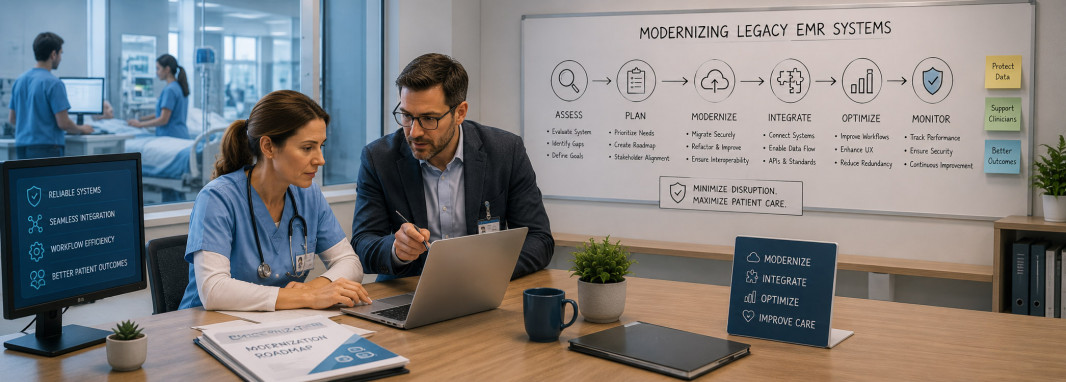
Many healthcare organizations know their legacy EMR systems are holding them back.
The problem is not awareness.
The problem is risk.
Clinical teams depend on stable workflows, immediate record access, and uninterrupted patient operations.
Any modernization effort that disrupts care can create operational chaos, provider frustration, and compliance exposure.
The good news is that EMR modernization does not require reckless full replacement.
With the right strategy, healthcare organizations can modernize safely while maintaining clinical continuity.
Why Legacy EMR Systems Become a Business Problem
Older EMR platforms often worked well when originally deployed.
Over time, operational demands evolve while technical infrastructure stays frozen.
Common symptoms include:
- slow performance
- poor usability
- limited integration support
- manual workflows
- fragmented patient records
- high maintenance costs
- reporting limitations
- compliance concerns
At some point, the issue becomes operational sustainability rather than software age.
Modernization Does Not Always Mean Full Replacement
One of the biggest mistakes healthcare organizations make is assuming modernization means destroying everything and starting over.
That approach creates unnecessary risk.
Modernization strategies may include:
- core platform refactoring
- modular system replacement
- middleware integration layers
- workflow redesign
- UI modernization
- document infrastructure upgrades
- data architecture restructuring
Organizations pursuing legacy EMR modernization often achieve better outcomes through phased transformation instead of complete disruption.
Start With Workflow Mapping
Technology should support clinical operations.
That means modernization starts with understanding how care actually happens.
Key questions:
- how providers document encounters
- how records move between teams
- where manual bottlenecks exist
- which workflows create delays
- what staff complain about most
Without workflow mapping, modernization risks rebuilding the same inefficiencies inside newer software.
Stabilize Patient Data First
Patient data continuity is non-negotiable.
Legacy systems often contain years of inconsistent information.
Common issues:
- duplicate patient records
- broken document relationships
- incomplete clinical history
- legacy schema mismatches
- inconsistent coding structures
Structured patient data modernization protects operational integrity while creating a stronger foundation for long-term scalability.
Avoid Big-Bang Replacement
Replacing everything at once creates maximum risk.
Healthcare environments have too many operational dependencies.
A big-bang transition often leads to:
- staff confusion
- clinical slowdown
- integration failures
- data access problems
- billing disruption
- patient frustration
Phased modernization reduces operational shock.
Safer rollout models may separate infrastructure, workflows, integrations, and user-facing modules.
Preserve Clinical Access During Transition
Providers need uninterrupted access to critical information.
Modernization plans should explicitly protect:
- patient histories
- medication records
- lab data
- care plans
- diagnostic documentation
- visit histories
Access continuity is part of patient safety.
Fix Integrations Early
Legacy EMR platforms rarely operate alone.
Connected systems often include:
- billing software
- diagnostic systems
- telehealth tools
- patient portals
- CRM workflows
- insurance processing
- document repositories
Broken integrations create invisible operational damage.
Integration architecture should be addressed early rather than patched after launch.
Prepare Staff for Change
Clinical software success depends heavily on adoption.
Even strong technology fails when users are not prepared.
Healthcare organizations should plan:
- workflow-specific training
- role-based onboarding
- pilot user testing
- feedback loops
- go-live support teams
Operational confidence reduces transition friction.
Build Compliance Into Modernization
Modernization creates a chance to improve governance.
Healthcare platforms should strengthen:
- audit trails
- access governance
- encryption architecture
- document traceability
- API security
- data retention controls
Compliance improvements should be intentional, not incidental.
Measure Success Beyond Go-Live
Deployment is not the endpoint.
Success metrics should include:
- provider productivity
- workflow speed
- record accuracy
- integration stability
- staff satisfaction
- patient operational experience
Real modernization improves operational outcomes, not simply technology freshness.
Final Thoughts
Legacy EMR modernization does not have to disrupt patient care.
The safest strategy focuses on phased transformation, workflow continuity, stable data architecture, and controlled operational change.
Healthcare organizations that modernize deliberately usually reduce risk while creating stronger foundations for future growth.