economy and refugees by hiring Ukrainian Software Developers - we donate a lot to charities and volunteer foundations


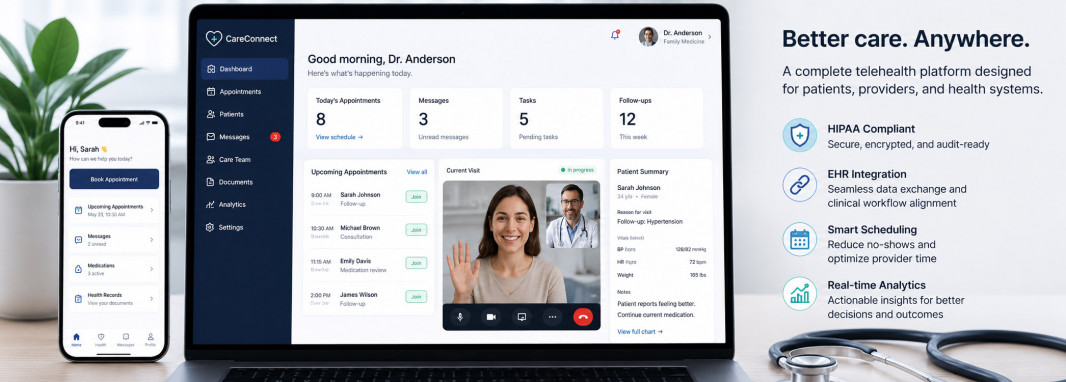
The telehealth market continues growing rapidly, reaching nearly $197 billion in 2025, but market growth alone hides a much more difficult reality: many telehealth platforms struggle with long-term adoption after their initial launch phase. Products attract early users, generate interest from investors and healthcare providers, and then slowly lose momentum because clinicians stop using them regularly, patients fail to return after several visits, or operational friction begins creating problems at scale.
The platforms that survive long term are usually not the ones with the largest feature lists or the most aggressive marketing. The strongest products are the ones that solve a very specific healthcare workflow problem better than existing alternatives while fitting naturally into the daily routines of both patients and clinicians. Organizations building scalable telehealth software development solutions increasingly discover that successful virtual care platforms depend far more on workflow alignment, operational simplicity, clinician adoption, and retention strategy than on adding more technical functionality.
The Biggest Telehealth Problem Is Not Technology
During the rapid telehealth expansion between 2020 and 2022, many healthcare companies assumed virtual care adoption would permanently remain at emergency-era levels. What actually happened was far more nuanced.
Patients embraced telehealth strongly for very specific use cases such as behavioral health consultations, prescription refills, chronic disease management, follow-up appointments, dermatology, and routine care interactions that did not require physical examination. At the same time, many patients continued preferring in-person visits for more complex consultations or situations requiring direct physical assessment.
Clinicians reacted in a similarly selective way.
Healthcare providers accepted telehealth when it improved operational efficiency, expanded access to care, or simplified patient communication. However, many clinicians quickly resisted platforms that introduced additional administrative burden, unstable workflows, poor documentation systems, or complicated technical processes that increased workload during already demanding schedules.
As a result, generalized “virtual care platforms” often struggled with retention while more focused telehealth products serving clearly defined care scenarios achieved much stronger long-term adoption.
This creates the most important early product question for any telehealth platform.
What specific healthcare delivery problem does this platform solve better than the current alternative?
Without a clear answer, adoption usually weakens over time regardless of how sophisticated the technology appears.
Telehealth Platforms Must Serve Two Completely Different User Groups
Telehealth products face a difficult design challenge because they must satisfy two audiences with fundamentally different priorities: patients and clinicians.
Optimizing heavily for one side while neglecting the other almost always creates adoption problems later.
The Patient Experience
For patients, telehealth success depends heavily on reducing friction between the moment they decide they need care and the moment they actually receive it.
Every additional technical step creates risk.
Confusing registration flows, complicated identity verification, unclear insurance handling, browser permission issues, difficult scheduling systems, or unstable video setup processes all become potential abandonment points before the visit even begins.
The highest-friction moments usually include account creation, insurance validation, appointment scheduling, camera and microphone permissions, and post-visit follow-up communication.
Strong telehealth platforms reduce this friction aggressively.
Many mature systems integrate directly with existing patient accounts or hospital credentials instead of forcing users into entirely new registration processes. Insurance eligibility verification increasingly happens quietly in the background rather than interrupting appointment booking flows with administrative complexity.
Video setup remains one of the largest usability failures across the industry, especially among older patient populations. Browser-based permission prompts consistently generate support requests because many patients are uncomfortable troubleshooting technical settings during healthcare interactions.
This is one reason native mobile applications often outperform browser-based telehealth experiences. Native applications allow more reliable camera permissions, stronger notification handling, better video stability, and a more controlled overall experience.
Patients judge telehealth products extremely quickly.
If the first interaction feels stressful or confusing, long-term trust declines immediately.
The Clinician Experience
Clinicians evaluate telehealth platforms very differently from patients.
The primary concern for healthcare providers is operational efficiency.
If virtual visits require more administrative effort, more documentation work, or more workflow management than in-person encounters, clinicians quickly become resistant to the platform regardless of how attractive the patient experience appears.
Healthcare providers already operate under heavy administrative pressure.
Additional friction creates immediate frustration.
Successful clinician-facing experiences minimize administrative visibility as much as possible. Documentation should pre-populate intelligently where appropriate. Billing workflows should operate contextually. EHR synchronization should happen quietly in the background without requiring duplicate manual data entry.
Ambient documentation tools are becoming increasingly important here as well. AI-assisted note generation during virtual visits is rapidly shifting from an experimental feature into an expected operational capability, especially in physician-focused workflows where documentation burden remains extremely high.
Clinicians consistently adopt systems that reduce operational friction.
They consistently abandon systems that increase it.
Compliance Architecture Must Be Built From the Beginning
Many telehealth companies describe themselves as “compliance-first,” but in practice compliance often becomes a later-stage legal review instead of a foundational architectural decision.
Strong telehealth systems treat compliance very differently.
They build infrastructure around compliance requirements from the beginning.
Video Infrastructure and Security
HIPAA-compliant telehealth video involves much more than encryption alone.
Platforms require Business Associate Agreements with infrastructure vendors, strong authentication controls, audit logging, session governance, and secure access management throughout the entire workflow. Consumer-grade communication tools are not automatically healthcare compliant simply because they support encrypted communication.
Most production-grade telehealth systems rely on HIPAA-eligible infrastructure such as Twilio, AWS Chime SDK, or healthcare-configured Zoom environments because these platforms provide stronger operational control over security, mobile reliability, latency, and infrastructure management.
Video quality itself directly affects clinical quality as well.
Different medical specialties require different levels of visual fidelity, and adaptive bitrate streaming becomes critically important for patients operating in low-bandwidth environments where unstable connections can interrupt care delivery.
PHI and Infrastructure Design
Every message, uploaded image, prescription, document, and clinician note exchanged through telehealth becomes protected health information.
This dramatically changes infrastructure requirements.
Mature telehealth architectures separate PHI-sensitive systems from operational analytics environments and enforce strict access governance at the infrastructure layer rather than relying solely on application-level permissions.
Data residency rules further complicate infrastructure planning because several jurisdictions enforce healthcare privacy requirements extending beyond HIPAA itself. Organizations operating across multiple states must carefully control where healthcare data is stored, processed, and transmitted.
Prescribing and Regulatory Complexity
Prescribing through telehealth introduces another major layer of legal and operational complexity.
Controlled substances, state licensing rules, and evolving DEA telemedicine regulations create meaningful risk if compliance workflows are poorly designed during early development.
Many organizations reduce exposure by initially launching in states with simpler regulatory environments before gradually expanding operational coverage as governance processes mature.
Why EHR Integration Determines Whether Telehealth Scales
Standalone telehealth systems disconnected from the patient’s primary clinical record face major operational limitations.
Health systems increasingly prioritize platforms capable of deep integration with enterprise EHR software development environments rather than disconnected standalone tools because fragmented workflows eliminate much of the efficiency telehealth is supposed to create.
Without proper integration, clinicians manually transfer notes, medications, treatment plans, and visit information into the EHR after every consultation. This increases administrative burden while also creating clinical risk through transcription errors, incomplete records, and delayed documentation visibility.
Real-world EHR integration is rarely simple.
Each healthcare organization typically maintains its own governance process, API configuration standards, interoperability requirements, security reviews, and testing procedures. Production integrations with enterprise health systems often require months rather than weeks.
Organizations that underestimate this complexity usually experience serious operational pain later.
Retention Is Harder Than Initial Adoption
One of the biggest telehealth misconceptions is assuming that user acquisition automatically creates long-term product success.
Retention is usually much harder.
Patient Retention
Patient engagement often follows a predictable pattern: strong initial adoption followed by gradual decline after several interactions.
The most common causes include unclear platform purpose, fragmented follow-up workflows, weak between-visit communication, and lack of meaningful long-term engagement.
Platforms with stronger retention usually focus on a clearly defined care category, maintain communication between visits, simplify follow-up scheduling, and support asynchronous communication for chronic disease management where appropriate.
Asynchronous care becomes especially valuable for chronic conditions because patients often require continuous support without needing constant live video appointments.
Clinician Retention
Clinicians are often even less tolerant of poor experiences than patients.
Technical failures during early usage correlate very strongly with long-term abandonment. Documentation delays, unstable video quality, scheduling complexity, weak EHR synchronization, and workflow interruptions quickly destroy clinician trust.
Organizations investing heavily in onboarding, operational reliability, and real-time support during early usage typically achieve much stronger institutional adoption later.
The Platforms That Win Understand Workflow Reality
By 2025 and 2026, simply offering virtual visits no longer creates meaningful differentiation.
The telehealth platforms succeeding long term are the ones improving healthcare delivery for clearly defined patient and clinician groups while aligning workflow design, technical architecture, compliance infrastructure, retention strategy, and operational reliability around that objective.
The strongest companies consistently begin with operational realities first.
They understand how clinicians actually work, where patients experience friction, how healthcare organizations manage compliance, and how infrastructure decisions affect care delivery at scale.
Only after understanding those constraints do they build technology around them.
That order matters far more than most telehealth startups initially realize.