economy and refugees by hiring Ukrainian Software Developers - we donate a lot to charities and volunteer foundations

The healthcare sector is facing a severe crisis due to operational overload. In 2026, clinical burnout has reached unprecedented levels, with physicians spending up to 50% of their workday clicking through Electronic Health Records (EHR) and completing compliance paperwork. This documentation burden acts as a tax on healthcare delivery, reducing patient face-time and straining clinical capacity.
Voice AI has evolved far beyond basic consumer dictation or rigid interactive voice response (IVR) systems. Modern systems leverage Ambient Clinical Intelligence (ACI), advanced speech-to-text engines, domain-specific large language models (LLMs), and secure real-time audio streaming. These technologies allow digital health platforms to convert un-structured clinical conversations into structured, billable, and actionable medical data.
Building or procuring an enterprise-grade voice AI system for healthcare requires addressing complex challenges in audio engineering, clinical accuracy, data governance, and deep EHR integration. This comprehensive guide provides a technical overview of architecture, implementation strategies, and compliance frameworks required to deploy voice AI solutions in enterprise healthcare environments.
1. The Core Capabilities: Architectural Domains of Healthcare Voice AI
A mature enterprise digital health platform requires a voice AI framework divided into three separate functional domains. Each domain relies on unique architectural components, data ingestion pipelines, and user experience paradigms.
Domain A: Ambient Clinical Documentation (Ambient Scribing)
Ambient scribing runs passively in the background during patient-provider encounters, removing the need for active commands or manual data entry.
- The Workflow: The clinician activates a secure app on a mobile device, tablet, or workstation. The system captures the natural, un-structured dialogue between the clinician and patient, ignoring small talk and non-clinical tangents.
- The Artifact: Within seconds of the encounter ending, the platform generates a structured SOAP note (Subjective, Objective, Assessment, Plan), lists relevant ICD-10/CPT codes, and drafts patient discharge instructions.
- Clinical Impact: Real-world implementations of ambient AI scribes show up to a 51% reduction in documentation time and a 30% drop in reported clinician burnout (Suki AI, 2026).
Domain B: Conversational Voice Assistants (Point-of-Care Interactivity)
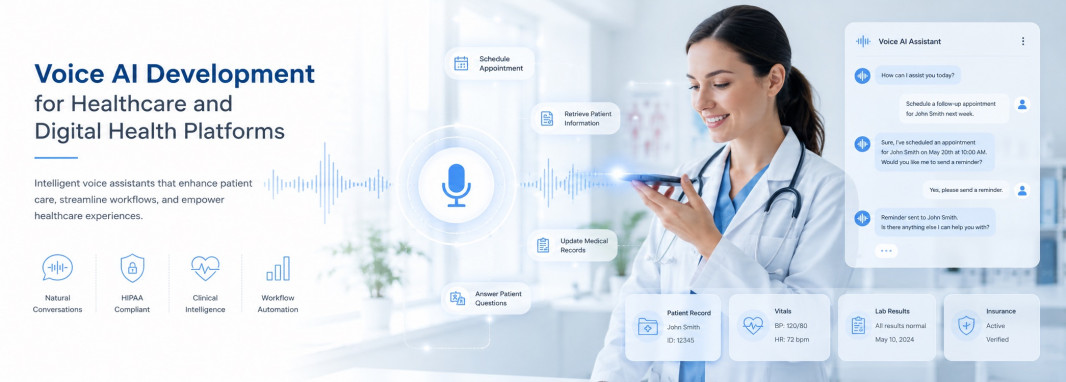
Unlike passive ambient systems, conversational assistants process intentional, direct voice commands from clinicians navigating software while their hands and eyes are occupied.
- Hands-Free Charting: "Voice Assistant, pull up the patient’s last lipid panel and append 50mg Losartan to their active medications."
- Contextual Retrieval: Querying the patient's longitudinal record during an exam or surgical procedure using natural language processing (NLP) to retrieve historical data without manual clicks.
Domain C: Automated Patient Support & Telehealth Triaging
This customer-facing domain automates inbound and outbound interactions, handling patient access, scheduling, and remote monitoring.
- Intelligent Patient Intake: Autonomous voice agents process natural speech over telephone lines (PSTN/SIP) or mobile apps to schedule appointments, verify insurance information, and complete pre-visit screening questionnaires.
- Post-Discharge Monitoring: Outbound voice agents contact patients to check on medication adherence, log patient-reported outcomes (PROs), and automatically escalate complex cases to human care managers based on predefined clinical triage algorithms.
2. Deep-Dive: Enterprise Architecture for Clinical Voice AI
Developing a clinical voice system requires a multi-layered architecture capable of handling highly variable audio data while maintaining near-zero latency and high analytical accuracy.
| Architecture Layer | System Components & Technology Description | Data Transfer Protocol (Next Step) |
|---|---|---|
| 1. APPLICATION LAYER | • Mobile/Web Client SDKs (Patient/Provider Apps) • SIP/PSTN Telephony (Inbound/Outbound calls) • EHR Embedded UI (Integrated workspace interfaces) | 🟢 WebSockets / RTP Stream (Real-time raw audio streaming) |
| 2. VOICE PIPELINE LAYER | • Advanced Audio Prep: Acoustic Echo Cancellation (AEC) & Noise Reduction • Clinical ASR Engine: Speech-to-text with domain-specific medical vocabulary • Speaker Diarization: Neural voice separation (Provider vs. Patient) | 🟢 Speaker IDs + Normalized Text (Cleaned and tagged transcript transfer) |
| 3. CLINICAL REASONING LAYER | • Entity Extraction (NER): Code mapping for RxNorm, SNOMED CT, and ICD-10 • LLM Prompt / Context: Structuring the transcript into specialized formats (e.g., SOAP) • Structured Output: Data validation via JSON Schema or Pydantic layers | 🟢 HTTPS / TLS 1.3 (Secure transfer of structured medical data) |
| 4. DATA & EHR INTEGRATION | • Epic Systems (App Market / App Orchard) • Oracle Health (formerly Cerner) • HL7 FHIR Store (Central longitudinal patient records) | 🏁 Final Destination (Permanent writeback to the patient's medical record) |
The Ingestion & Audio Processing Pipeline
Raw audio from medical environments is often compromised by background noise, echoes, and physical distance from the microphone.
Acoustic Front-End (AFE): Raw pulse-code modulation (PCM) audio streams through WebSockets or Secure Real-time Transport Protocol (SRTP). The pipeline applies webRTC-based Acoustic Echo Cancellation (AEC) and directional blind source separation to clean the signal.
Clinical Automatic Speech Recognition (ASR): General-purpose ASR models often struggle with complex medical terminology. Enterprise systems require domain-specific models trained on clinical vocabularies. For instance, general speech benchmarks may show low overall error rates, but tools like standard Whisper-large-v3 can experience a 13.1% keyword error rate specifically on medical terms like drug names and anatomical structures when processing real-world clinical audio (Deepgram, 2026). Incorporating a dedicated medical mode can reduce medical entity errors by up to 87%, ensuring accurate capturing of critical terms such as "metoprolol" versus "metformin".
Neural Speaker Diarization: The system must distinguish between distinct speakers in real time. The pipeline partitions the audio stream into homogeneous segments assigned to unique speaker IDs (e.g., Speaker_0: Clinician, Speaker_1: Patient, Speaker_2: Family_Member). Without accurate diarization, symptoms reported by the patient can be mistakenly attributed to the clinician's observations, corrupting the downstream medical record.
The Clinical Reasoning & Structuring Engine
Once the audio is converted into a normalized, speaker-tagged transcript, it passes to the Natural Language Processing and Generative AI layer.
Contextual Tokenization & Chunking: Long clinical encounters are broken into semantic blocks, preserving the chronological flow of the patient interview.
Clinical Entity Recognition (NER): Custom models map spoken phrases to standardized medical vocabularies:
- RxNorm for medications and dosages.
- SNOMED CT for clinical findings and symptoms.
- ICD-10-CM for diagnostic billing codes.
LLM Orchestration via Structured Schema Guardrails: The refined transcript, along with relevant patient history fetched from the EHR, is fed into a healthcare-tuned LLM. To guarantee the output matches the target system's specifications, engineers enforce strict formatting via tools like JSON Schema or Pydantic validation layers.
EHR Integration Architecture
A standalone voice application that operates outside the primary EHR interface adds operational friction. Successful voice AI architectures require native, bi-directional integration with major EHR ecosystems like Epic, Oracle Health (Cerner), and Athenahealth.
SMART on FHIR (Fast Healthcare Interoperability Resources): The voice AI platform launches as an embedded iframe or view container within the clinician's workspace using OAuth 2.0 authentication. Patient context (such as Patient_ID and Encounter_ID) passes automatically to the voice assistant, avoiding manual record matching.
Bi-Directional Rest APIs: The voice app reads historical patient data (e.g., allergies, current medications) via standard GET requests to tailor the AI's contextual awareness. Once the clinical note draft is approved by the provider, the platform uses a POST or PUT request to write the structured markdown or JSON directly into the EHR's documentation module.
3. Compliance, Security, and Governance Frameworks
In clinical environments, data security and regulatory compliance are foundational requirements rather than optional features. A single security failure can lead to significant regulatory penalties and compromise patient trust.
HIPAA and Data Protection Frameworks
Under the Health Insurance Portability and Accountability Act (HIPAA) in the United States, and similar international frameworks like GDPR in Europe, any voice AI platform processing Protected Health Information (PHI) must implement comprehensive technical safeguards.
Business Associate Agreements (BAAs): The voice AI vendor must sign a formal BAA with the healthcare provider and execute matching agreements with all downstream infrastructure providers (such as cloud hosting or model API vendors). These agreements legally prohibit using patient audio data or transcripts to train public, non-blinded underlying AI models.
Cryptographic Isolation: All PHI must be encrypted both in transit and at rest.
- In Transit: Minimum TLS 1.3 encryption for WebSockets and HTTPS traffic, and SRTP utilizing AES-256 for live telephony feeds.
- At Rest: Full disk and database encryption using AES-256 with customer-managed cryptographic keys (CMK) via cloud Key Management Services (KMS).
Risk Management and Security Auditing
Comprehensive Audit Trail Logs: The platform must record immutable log entries for every data access event, creation of an ambient transcript, or EHR update. These logs should track user identity, access timestamps, IP addresses, and specific data elements viewed or altered, feeding directly into security information and event management (SIEM) systems.
Regulatory Compliance Frameworks: Production platforms require third-party verification of their security posture.
- SOC 2 Type II Certification: Annual verification of operational controls across security, availability, and confidentiality.
- ISO/IEC 27001: Adherence to structured international standards for information security management systems.
Clinical Risk Management: Eliminating Hallucinations and Omissions
Large language models can sometimes emit factually incorrect info (hallucinations) or drop vital clinical data (omissions). In digital health, these tendencies pose direct risks to patient safety.
The Human-In-The-Loop Mandate
Voice AI systems function strictly as an administrative aid rather than an autonomous medical entity. The platform must operate under a "Human-In-The-Loop" model. The AI drafts the clinical documentation, but the licensed healthcare provider retains full ownership and accountability. The clinician must explicitly review, edit, and sign off on the draft text before it is officially committed to the patient’s permanent medical record.
To reduce clinical risk, platforms use several key techniques:
- Retrieval-Augmented Generation (RAG): Restricting the LLM’s focus to the exact contents of the verified acoustic transcript and explicit EHR background data, rather than allowing it to rely solely on internal parametric knowledge.
- Automated Discrepancy Spotting: Running secondary, deterministic NLP validation passes to verify that any prescription or dosage mentioned in the text matches the transcript, flagging discrepancies before presentation to the physician.
4. Total Cost of Ownership (TCO) & ROI Evaluation
Implementing enterprise voice AI involves a balance of upfront platform costs and long-term operational efficiency gains.
Cost Structure Dynamics
When evaluating a voice AI solution, procurement teams must look past basic per-seat software licensing fees to calculate total operational costs across four areas:
| Cost Category | Key Components & Driver Details |
|---|---|
| Platform Licensing | Annual per-seat subscriptions, tier-based user access controls, and volume discounts for large networks. |
| API Ingestion & Compute | Audio transcription rates (typically measured per minute or hour), along with LLM token processing fees. |
| Integration & Professional Services | Custom EHR writeback development, HL7 interface mapping, and specialty-specific prompt engineering. |
| Change Management & Training | Clinician onboarding programs, support staff training, and initial workflow optimization. |
Quantifiable Return on Investment (ROI)
The financial return from a successful voice AI rollout typically comes from three distinct operational improvements:
- Reclaiming Clinical Hours: Reducing documentation time by 2-3 hours per physician each day allows clinics to increase daily patient volume by 10-15% without adding to provider stress.
- Accelerated Billing & Reduced Denial Rates: Integrating real-time medical coding suggestions (ICD-10, CPT, HCC) ensures that diagnostic specificity is captured directly at the point of care. This reduces down-the-line coding errors, speeds up claims submission, and minimizes insurance rejections.
- Improved Retention and Reduced Turnover: Minimizing administrative burdens helps mitigate physician burnout, directly reducing the high recruitment costs associated with clinical turnover.
5. Strategic Evaluation Checklist for Healthcare Executives
When assessing voice AI vendors or planning an in-house build, technology leaders can use this structured checklist to ensure technical viability, compliance, and clean workflow integration:
- Data Ownership and Model Policy: Does the vendor explicitly state in the BAA that patient audio and transcripts will not be used for foundational model training?
- Medical Terminology Benchmarks: What is the vendor's Word Error Rate (WER) and Medical Character Error Rate specifically for your high-volume clinical specialties?
- EHR Integration Capabilities: Does the solution support native SMART on FHIR bi-directional writeback, or does it rely on basic clipboard copy-pasting?
- Advanced Speaker Handling: Does the system feature verified speaker diarization that clearly separates doctor, patient, and family voices in noisy clinical environments?
- Offline Resilience Infrastructure: If network connectivity drops mid-encounter, does the client SDK securely cache encrypted audio locally to prevent data loss?
- Scalable Identity Governance: Does the platform support enterprise single sign-on (SSO) alongside role-based access control (RBAC) and mandatory multi-factor authentication (MFA)?
Conclusion: The Path Forward for Digital Health Platforms
Voice AI has shifted from an emerging experimental technology to a core requirement for modern digital health infrastructure. By successfully deploying ambient clinical intelligence and natural voice interfaces, platforms can strip away layers of administrative friction, letting providers shift their focus from computer screens back to the patients in front of them.
The successful implementation of clinical voice platforms requires equal attention to technical performance, domain-specific design, and rigorous data governance. Whether you are building an in-house solution from scratch or looking to extend your platform's existing capabilities with advanced voice features, navigating the complexities of healthcare compliance and medical data orchestration demands specialized engineering expertise.
For platforms seeking a collaborative development partner to build, scale, or integrate these advanced voice systems, Zfort Group offers deep expertise in custom digital health engineering. Our teams specialize in navigating high-security architectures, HIPAA/GDPR compliance frameworks, and seamless EHR integrations, helping turn advanced conversational concepts into secure, production-ready healthcare applications.