economy and refugees by hiring Ukrainian Software Developers - we donate a lot to charities and volunteer foundations

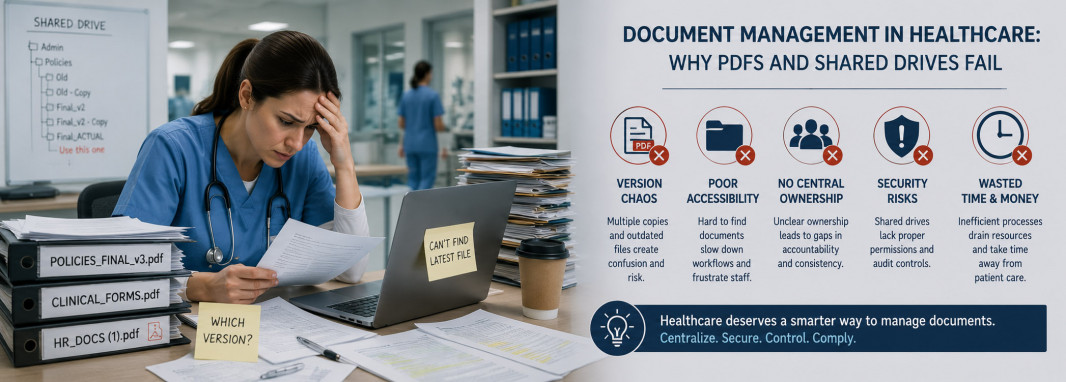
Many healthcare organizations still rely on PDFs, folders, email attachments, and shared drives to manage critical documentation.
That approach may feel familiar.
At scale, it creates operational inefficiency, compliance risk, poor visibility, and growing workflow friction.
Healthcare documentation is far too operationally critical for improvised storage systems.
As organizations grow, document management becomes infrastructure rather than administrative housekeeping.
Healthcare Documentation Is More Complex Than Standard Business Files
Healthcare environments manage large volumes of structured and unstructured information.
This may include:
- patient intake forms
- lab reports
- signed consent forms
- insurance documentation
- referrals
- clinical attachments
- treatment records
- discharge summaries
- compliance documentation
These documents support real clinical workflows.
They are not ordinary office files.
Shared Drives Destroy Visibility
One of the biggest problems with shared folders is poor visibility.
Teams often struggle to answer simple operational questions:
- which document is current
- who changed it
- where the signed version lives
- whether staff are using the correct file
- who accessed sensitive documentation
Without document governance, healthcare teams lose time searching, duplicating work, and validating information manually.
PDF-Based Workflows Create Operational Friction
PDFs solve portability.
They do not solve workflow management.
Common operational issues include:
- manual downloads
- email back-and-forth approvals
- duplicate attachments
- version confusion
- inconsistent naming conventions
- lost signed copies
What feels manageable at small scale becomes expensive operational drag across growing healthcare organizations.
Purpose-built medical document management software creates significantly stronger control, visibility, and workflow reliability.
Version Control Becomes a Hidden Risk
Healthcare teams frequently work with evolving documentation.
Examples include updated care plans, revised referrals, insurance revisions, consent changes, and compliance materials.
Without version governance:
- outdated documents remain active
- duplicate versions circulate
- staff act on incorrect information
- audits become difficult
Version chaos creates both operational and compliance exposure.
Security and Access Governance Break Down
Healthcare documentation contains sensitive information.
Shared folders rarely provide strong governance at operational scale.
Common risks include:
- overly broad permissions
- unclear access ownership
- weak audit visibility
- inconsistent document restrictions
- manual permission management
Healthcare organizations need stronger governance than generic file storage provides.
Disconnected Documents Damage Patient Data Integrity
Documents should not exist outside healthcare data architecture.
When records live across disconnected drives, email attachments, PDFs, and isolated repositories, patient context becomes fragmented.
This creates:
- broken care continuity
- missing clinical context
- duplicate patient information
- inconsistent records
- reporting blind spots
Structured healthcare data governance helps healthcare organizations connect documents with broader operational patient information.
Compliance Expectations Keep Growing
Healthcare compliance requires controlled information governance.
That includes:
- audit trails
- role-based access controls
- document traceability
- retention governance
- secure information access
- change history visibility
Improvised file-sharing infrastructure makes these requirements difficult to manage consistently.
Searching for Information Wastes Time
Administrative inefficiency becomes expensive quickly.
Teams lose time searching through nested folders, email threads, old exports, and duplicated storage locations.
Operational friction compounds daily.
What looks like minor inefficiency often becomes significant payroll waste at scale.
Growth Makes Everything Worse
Small clinics sometimes tolerate imperfect file management.
Multi-location operations expose structural weakness fast.
Growth increases:
- document volume
- access complexity
- cross-team collaboration
- compliance exposure
- workflow dependencies
Unstructured document systems rarely scale cleanly.
What Modern Healthcare Document Management Should Provide
Effective healthcare document systems typically support:
- centralized document control
- version management
- role-based permissions
- audit trails
- document indexing
- workflow automation
- patient-linked records
- searchable metadata
- secure sharing
Document infrastructure should support operations, not slow them down.
Final Thoughts
PDFs and shared drives may feel familiar, but familiarity is not scalability.
Healthcare organizations that continue relying on improvised document workflows often create hidden cost, compliance exposure, and operational friction.
Modern document management creates stronger control, better workflow efficiency, and safer healthcare operations.