economy and refugees by hiring Ukrainian Software Developers - we donate a lot to charities and volunteer foundations

The healthcare industry is experiencing a profound paradigm shift. As medical data explodes in volume and complexity, the traditional reliance on manual clinical review is facing unprecedented scalability challenges. Radiologists are burning out, diagnostic backlogs are growing, and the margin for human error remains a persistent concern.
Enter Computer Vision (CV), a field of artificial intelligence that has evolved from a futuristic research concept into a foundational pillar of modern HealthTech.
By enabling machines to see, interpret, and analyze medical imagery and clinical environments with superhuman consistency, computer vision is unlocking new frontiers in patient care. For HealthTech innovators, healthcare providers, and enterprise stakeholders, investing in computer vision is no longer about staying ahead of the curve; it is about defining the curve.
This comprehensive guide explores how computer vision is transforming medical imaging, driving diagnostic support, and automating clinical workflows, while outlining the rigorous implementation requirements necessary to bring these solutions to life.
The Landscape of Medical Imaging: Enhancing the Clinical Eye
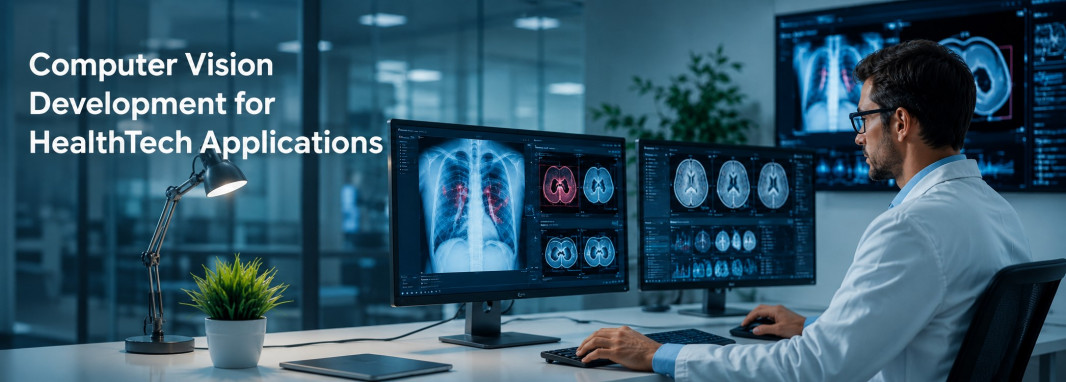
Medical imaging is the bedrock of modern diagnostics. Millions of X-rays, MRIs, CT scans, and ultrasounds are generated daily worldwide. However, the raw data locked within these pixels is only as valuable as the speed and accuracy with which it can be interpreted. Computer vision acts as a force multiplier for clinicians, turning static images into dynamic, actionable insights.
1. Advanced Image Segmentation
At the core of CV in medical imaging is semantic and instance segmentation. Instead of a radiologist manually tracing the boundaries of a complex brain tumor across dozens of MRI slices, which is a process both time-consuming and prone to intra-observer variability, deep learning models can segment structures in seconds.
By training convolutional neural networks (CNNs) or vision transformers (ViTs) on pixel-level annotated datasets, computer vision systems can isolate organs, identify anatomical anomalies, and delineate tumor margins with millimeter-level precision. This is critical not only for diagnosis but also for radiation therapy planning, where sparing healthy tissue is paramount.
2. Multi-Modal Fusion
Modern medicine rarely relies on a single imaging modality. A comprehensive oncology assessment might require combining structural data from a CT scan with metabolic data from a PET scan. Advanced computer vision architectures excel at multi-modal registration and fusion.
These algorithms align images taken at different times, from different angles, or via different modalities into a single, cohesive visual framework. This holistic view provides clinicians with a multi-dimensional understanding of a patient’s pathology that would be incredibly difficult to piece together mentally.
3. Dynamic Reconstruction and Super-Resolution
Acquiring high-resolution MRIs or CT scans often requires patients to remain perfectly still inside a noisy machine for extended periods. This is challenging for pediatric patients, elderly individuals, or those in acute pain.
Computer vision offers a solution through image super-resolution and reconstruction. By utilizing Generative Adversarial Networks (GANs) and diffusion models, HealthTech platforms can take low-dose, rapid-scan data and reconstruct high-fidelity, noise-free images. This reduces scan times, lowers radiation exposure, and improves patient comfort without sacrificing diagnostic quality.
Intelligent Diagnostics Support: Redefining Accuracy and Speed
Computer vision in HealthTech does not replace the physician; rather, it serves as an omnipresent, highly analytical co-pilot. In high-stakes diagnostic environments, computer vision algorithms act as a reliable safety net, catching subtle anomalies that the human eye might miss due to fatigue or cognitive overload.
Computer-Aided Detection (CADe) and Diagnosis (CADx)
Computer-aided systems have evolved significantly from the rigid, rule-based algorithms of the early 2000s. Today’s AI-driven CAD systems leverage deep neural networks to perform two distinct but complementary roles:
- Detection (CADe): Scanning large volumes of images to flag potential areas of concern, such as a tiny pulmonary nodule on a chest X-ray or a microcalcification in a mammogram.
- Diagnosis (CADx): Analyzing the flagged regions to assess the probability of malignancy or disease severity, providing clinicians with a probabilistic score to guide their decision-making.
Early Detection of Neurodegenerative and Retinal Diseases
One of the most profound impacts of computer vision is its ability to identify biomarkers long before physical symptoms manifest.
In ophthalmology, CV models analyze optical coherence tomography (OCT) fundus images to detect diabetic retinopathy, macular degeneration, and glaucoma at their earliest, most treatable stages. Similar breakthroughs are occurring in neurology, where subtle changes in cortical thickness or ventricular volume captured via MRI can signal the early onset of Alzheimer’s disease years before clinical cognitive decline is observable.
Real-Time Surgical Intelligence
The application of computer vision extends directly into the operating room. During minimally invasive surgeries, laparoscopy, or robotic-assisted procedures, real-time computer vision feeds can identify critical anatomical structures, map vascular networks beneath the tissue surface, and track surgical instruments. By providing real-time visual alerts when a surgeon gets dangerously close to a major blood vessel or nerve, CV significantly mitigates intraoperative risks.
Automation Opportunities: Streamlining Clinical and Operational Workflows
While diagnostic breakthroughs capture the headlines, the operational efficiencies unlocked by computer vision are equally transformative for the healthcare ecosystem. By automating repetitive visual tasks, HealthTech applications can drastically reduce administrative overhead and optimize resource allocation.
1. Intelligent Triaging and Workflow Prioritization
In a typical hospital emergency department, radiology queues operate on a first-come, first-served basis, or rely on manual, subjective triaging. Computer vision re-engineers this workflow through automated triage.
As soon as a scan is completed, a CV model runs a rapid preliminary analysis. If the algorithm detects a critical life-threatening condition, such as an intracranial hemorrhage on a head CT or a pneumothorax on a chest X-ray, it instantly elevates that study to the top of the radiologist’s reading queue. This cuts down the time-to-treatment from hours to minutes, saving lives in acute care scenarios.
2. Automated Quantitative Analysis
Clinicians spend a significant portion of their day performing manual measurements: calculating the ejection fraction of a heart on an echocardiogram, measuring fetal biometrics on an ultrasound, or counting cells on a pathology slide.
Computer vision automates these quantitative tasks. An AI model can instantly compute volumes, tracking changes over time across longitudinal studies with zero inter-operator variance. This frees up clinicians to focus on complex decision-making and direct patient interaction.
3. Patient Monitoring and Fall Detection
Beyond medical imaging, computer vision is modernizing inpatient care and long-term care facilities through smart video analytics. Using standard RGB or infrared cameras coupled with pose estimation algorithms, continuous monitoring systems can track patient movement without the need for intrusive wearable sensors.
These systems can detect if a patient is trying to leave their bed unassisted, assess their pressure ulcer risk by tracking movement frequency, and instantly alert nursing staff the moment a fall occurs.
Engineering the Solution: Partnering for Success
Building enterprise-grade HealthTech applications requires a rare blend of deep technical expertise, domain-specific knowledge, and an understanding of regulatory ecosystems. Tech leaders and innovators looking to implement these advanced capabilities often find that building everything from scratch in-house is an inefficient use of resources that stalls time-to-market.
This is where strategic engineering partnerships become invaluable. For companies seeking to design, develop, and scale robust computer vision systems, partnering with an experienced software development house is often the most viable path forward.
Partner Spotlight: Companies like Zfort Group serve as a prime example of a reliable technology partner in this space. With a deep bench of AI engineers and a proven track record in custom software engineering, Zfort Group can help HealthTech firms navigate the complexities of computer vision development. From designing custom neural network architectures and optimizing data pipelines to ensuring the final product integrates seamlessly with legacy hospital networks, their development expertise allows HealthTech companies to transform conceptual AI models into secure, scalable, market-ready clinical tools.
Leveraging external development expertise ensures that your internal teams can remain focused on core business strategies, clinical validation, and market adoption, while the technical heavy lifting is handled by seasoned engineering professionals.
Implementation Requirements: Navigating Technical, Regulatory, and Data Hurdles
Deploying computer vision in a laboratory setting is vastly different from deploying it into a live clinical workflow. To build a successful, sustainable HealthTech application, engineering and product teams must rigorously address a complex web of technical, operational, and regulatory requirements.
1. Data Quality, Curation, and Annotation
The adage "garbage in, garbage out" has never been truer than in medical AI. The performance of a computer vision model is intrinsically tied to the quality of its training data.
- Dataset Diversity: To prevent algorithmic bias, training datasets must encompass a wide demographic variety (age, gender, ethnicity) and include images captured from different hardware manufacturers, like Siemens, GE, or Philips, and imaging protocols. A model trained exclusively on high-end hospital scanners will likely fail when deployed in rural clinics using legacy equipment.
- Expert Annotation: Medical image annotation requires specialized clinical knowledge. Ground-truth labeling must be performed or validated by certified radiologists, pathologists, or physicians. Implementing multi-expert consensus workflows is crucial to resolve discrepancies in subjective annotations.
- Data Provenance: Maintaining a clean, auditable record of where data originated, how it was modified, and who annotated it is a fundamental requirement for both clinical validation and regulatory approval.
2. Architecture and Infrastructure Standards
HealthTech applications must operate within the strict, standardized digital infrastructure of modern healthcare ecosystems.
- DICOM Integration: Digital Imaging and Communications in Medicine (DICOM) is the universal standard for medical imaging. Any computer vision pipeline must natively ingest, parse, and output DICOM files, which includes preserving critical metadata headers while stripping out protected health information (PHI) where necessary.
- HL7 and FHIR Compliance: For a CV application to influence clinical workflows, it must communicate with Electronic Health Records (EHR) and Hospital Information Systems (HIS). Integration via HL7 or FHIR (Fast Healthcare Interoperability Resources) APIs ensures that AI findings are pushed directly into the patient's chart or the clinician's existing dashboard.
- Edge vs. Cloud Architecture: Developers must make strategic architectural choices regarding compute workloads. While the cloud offers massive scalability for non-urgent batch processing, such as longitudinal clinical trials, edge computing is often required for real-time applications like operating room analytics or intensive care unit monitoring where latency must be near-zero and internet connectivity cannot be guaranteed.
3. Regulatory Compliance and Quality Management
The regulatory pathway for medical software is stringent, requiring meticulous documentation and validation.
- FDA and CE Mark Approvals: In the United States, computer vision software that aids in diagnosis or treatment planning is classified as Software as a Medical Device (SaMD) and typically requires FDA 510(k) clearance or De Novo classification. In Europe, compliance with the Medical Device Regulation (MDR) is mandatory. Developers must prove both the safety and effectiveness of their algorithms through rigorous clinical evaluation.
- HIPAA and GDPR Compliance: Patient privacy is non-negotiable. HealthTech platforms must enforce strict data privacy controls. This includes implementing robust data anonymization pipelines at the edge before data ever hits the cloud, end-to-end encryption in transit and at rest, and comprehensive role-based access controls (RBAC) to ensure only authorized personnel can view patient-identifiable data.
4. Model Explainability and Interoperability
Medical professionals will not trust a "black box" algorithm, especially when making life-or-death decisions. If a computer vision model flags a region as a malignant tumor, it must provide context.
Implementing explainable AI (XAI) techniques, such as Grad-CAM (Gradient-weighted Class Activation Mapping), is essential. Grad-CAM generates heatmaps that overlay on the medical image, visually demonstrating to the clinician exactly which pixels and features influenced the neural network's decision. This transparency fosters clinical trust and allows the physician to quickly verify or dismiss the AI's suggestions.
The Road Ahead: Embracing the Future of HealthTech
Computer vision is fundamentally redefining the boundaries of what is possible in healthcare. By augmenting the capabilities of medical professionals, automating resource-intensive tasks, and extracting deep, sub-visual insights from medical data, computer vision development is driving a shift toward more proactive, precise, and personalized patient care.
However, the journey from an algorithmic prototype to a fully integrated, regulatory-compliant clinical solution requires navigating steep technical and operational hurdles. Success requires a meticulous approach to data quality, adherence to strict healthcare infrastructure standards, an unyielding commitment to regulatory compliance, and a clear focus on actionable clinical utility.
For organizations looking to lead this revolution, the path forward lies in marrying visionary medical concepts with world-class engineering execution. By assembling the right internal teams, establishing rigorous development protocols, and collaborating with proven technology partners, HealthTech innovators can successfully bring the power of computer vision to the frontlines of medicine, ultimately improving clinical outcomes and saving human lives.