economy and refugees by hiring Ukrainian Software Developers - we donate a lot to charities and volunteer foundations



Every successful product starts with an idea. But an idea alone is not enough to build a business around it.
Many startups and product teams make the same mistake: they rush into full-scale development before they know whether real users actually need the product. They spend months adding features, polishing design, and building complex functionality, only to discover later that the market does not care, the problem is not painful enough, or the solution does not fit the way people really work.
That is exactly why MVP development exists.
A minimum viable product, or MVP, is the simplest usable version of a product that helps you test your core idea with real users. It is not a rough draft, a cheap copy of the final product, or an excuse to launch something broken. A good MVP solves one clear problem, focuses on the must-have features, and gives your team enough feedback to decide what to do next.
The goal of an MVP is not to build everything at once. The goal is to learn quickly, reduce risk, and understand whether your product idea deserves more investment.
In this guide, we will walk through the MVP development process step by step: from shaping the initial idea and talking to potential users to cutting unnecessary features, building the first version, launching it, measuring feedback, and improving the product after real-world use.
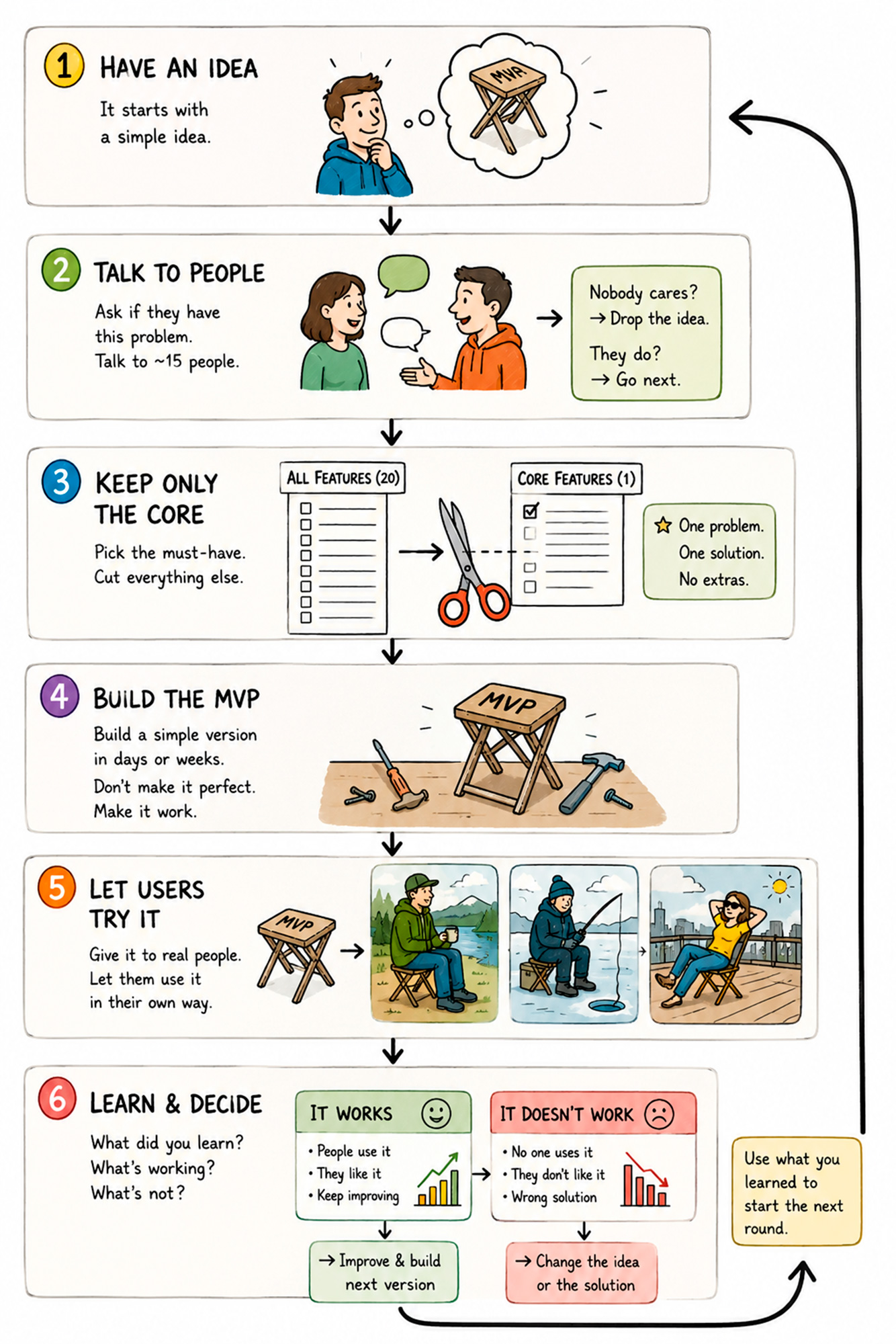
The MVP development process: have an idea, talk to people, keep only the core, build the MVP, let users try it, and learn what to do next.
Step 1. Have an Idea
Every MVP starts with an idea. It may come from a personal experience, a customer request, a market gap, or a problem your team has noticed in a specific industry.
At this stage, the idea may sound promising. You may already imagine the product, its features, its design, and even the way users will interact with it. But before investing time and money into full development, it is important to remember one thing: your idea is still only a hypothesis. Steve Blank describes this kind of structured thinking through the MVP tree, where a large product vision is broken down into smaller testable parts.
You are assuming that people have this problem. You are assuming that they care enough to look for a solution. You are assuming that they will use your product. You may also be assuming that they will pay for it.
MVP development helps you test these assumptions before you build a complex product. Instead of asking, “How can we build the full version?”, the better first question is, “What do we need to learn before we build more?”
Treat the Idea as a Hypothesis
This mindset changes the whole development process. You do not start by listing every possible feature. You start by defining the problem, the target users, and the main value your product should deliver.
For example, if you want to build a fitness app, the idea may be “an app for personalized workouts.” But the real hypothesis may be: “Busy professionals need short personalized workout plans they can follow at home without equipment.” That is much more specific, and it gives you something clear to test.
The same logic applies to SaaS platforms, marketplaces, healthcare products, fintech apps, AI tools, and internal business systems. A strong MVP does not try to prove that the whole product vision is correct at once. It tests the most important assumption behind the idea.
Before moving to development, write down your idea in one simple sentence:
We believe that [target users] need [solution] because [problem].
This simple statement will help you stay focused when you start talking to users, cutting features, and deciding what the first version of the product should include.
Step 2. Talk to People
Once you have a product idea, the next step is not design or development. The next step is talking to people who might actually use it.
This is where many founders make their first major mistake. They ask, “Do you like my idea?” instead of trying to understand whether people really have the problem the product is supposed to solve. The difference matters. People may politely say that an idea sounds interesting, but that does not mean they will use the product, change their current habits, or pay for it.
Before building an MVP, speak with potential users and focus on their real experience. Ask how they deal with the problem today, what tools they already use, what frustrates them, and what would make them look for a better solution.
What to Ask Potential Users
Good user interviews are not about pitching the product. They are about understanding the user’s current situation, pain points, habits, and decision-making process.
Useful questions may include:
- How do you currently solve this problem?
- How often does this problem happen?
- What makes it difficult or expensive?
- What have you already tried?
- What do you dislike about the current solution?
- Would solving this problem save you time, money, or effort?
The goal is not to sell the idea during these conversations. The goal is to learn whether the problem is real, frequent, and important enough to justify building a product. This reflects the idea that MVP is about learning, not simply building a cheaper version of the final product.
For example, if you want to create an AI-powered customer support tool, you should not start by asking companies whether they like AI chatbots. Instead, ask how many support requests they receive, where their team loses the most time, what questions are repeated most often, and what kind of automation they would actually trust.
These conversations help you separate assumptions from evidence. You may discover that users need a simpler product than you expected. You may also find that the original idea is too broad, the target audience is wrong, or the problem is not painful enough.
That is not failure. That is exactly what early validation is for.
The sooner you learn what users truly need, the less time and money you waste building features that do not matter. A strong MVP is not built around what the founder imagines. It is built around what real users confirm through their behavior, feedback, and pain points.
Turn Conversations Into a Clear MVP Direction
After the interviews, do not rush straight into feature planning. First, turn what you heard into a clear product direction: the core problem, the target user, and the riskiest assumption your MVP needs to test.
This is where user research becomes product strategy. The conversations should help you decide what the MVP is really about and what it should prove before you invest in a larger product.
Define the Core Problem
The core problem is the main pain point your product should solve. It should be specific enough to guide product decisions and narrow enough to be tested with a focused MVP.
At this stage, many teams still make the mistake of thinking too broadly. They try to validate the entire business idea at once: the audience, the design, the pricing, the feature set, the business model, and the long-term product vision. But an MVP works best when it is built around one core problem and one critical assumption.
For example, imagine you want to build a platform for restaurant inventory management. The full product could include supplier integrations, demand forecasting, staff permissions, dashboards, reports, alerts, and payment tools. But the core problem may be much simpler: restaurant managers lose time and money because inventory tracking is still manual, inconsistent, or disconnected from ordering.
Once the core problem is clear, it becomes much easier to decide what belongs in the MVP and what should wait.
Identify the Riskiest Assumption
The riskiest assumption is the belief that must be true for your product to succeed. If this assumption is wrong, the whole idea may need to change.
For example:
- A marketplace MVP may test whether buyers and sellers are willing to use a new platform.
- A healthcare MVP may test whether patients or doctors trust a digital workflow.
- A fintech MVP may test whether users are comfortable sharing financial data.
- An AI-powered MVP may test whether automation can produce useful enough results for real business tasks.
- A SaaS MVP may test whether teams will use the tool regularly, not just sign up once.
This step is important because it gives your MVP a clear purpose. You are not simply building a smaller version of the final product. You are building a focused version that helps you answer the most important question.
In the restaurant inventory example, the riskiest assumption might be: restaurant managers will regularly update inventory in a digital system if it saves them time during ordering.
In that case, the MVP does not need every advanced feature. It needs only enough functionality to test whether managers will actually use the core inventory workflow.
A useful way to define this is to write one MVP test statement:
We are building this MVP to learn whether [target users] will [take a specific action] because it helps them [solve a specific problem].
This statement keeps the team focused. It also makes feature decisions easier. If a feature does not help test the core assumption, it probably does not belong in the first version.
Step 3. Keep Only the Core
Once you know the core problem and the riskiest assumption, the next step is to cut the product down to its essential features.
This is often the hardest part of MVP development. Founders naturally want to include more: more functionality, more user roles, more integrations, more design details, more “just in case” features. The problem is that every extra feature increases development time, cost, and complexity. More importantly, it can distract from the real purpose of the MVP.
An MVP should not answer every possible user need. It should answer one main question:
Can this product solve the core problem well enough for users to care?
That means the first version should include only the features needed to deliver the main value. Everything else can wait.
Prioritize MVP Features
A simple way to prioritize MVP features is the MoSCoW method:
- Must-have: features the MVP cannot work without
- Should-have: useful features that can be added later if time and budget allow
- Could-have: nice additions for future versions
- Won’t-have for now: features that are intentionally left out of the MVP
For example, if you are building a food delivery MVP, the must-have features may include restaurant listings, menu browsing, order placement, payment, and basic delivery status. Features like loyalty points, advanced recommendations, promo campaigns, detailed restaurant analytics, or social sharing can be postponed.
If you are building an AI MVP for document processing, the must-have functionality may be uploading a document, extracting key data, reviewing the result, and exporting it. A full admin dashboard, multiple user roles, custom reporting, and advanced workflow automation may not be necessary for the first release.
The goal is not to make the product primitive. The goal is to make it focused.
A good MVP should feel small but useful. Users should be able to complete the main action, understand the value, and give feedback based on real experience. If the product is too limited to solve anything, it is not viable. But if it tries to do everything, it is no longer minimal.
Before development starts, review every planned feature and ask:
Does this feature help us test the core assumption?
If the answer is no, move it to the backlog. The fewer distractions your MVP has, the easier it becomes to build, launch, measure, and improve.
Choose the Right MVP Type
After you define the core feature set, you need to decide what kind of MVP is best for your idea. Not every MVP has to be a fully developed web or mobile application from day one.
The right MVP type depends on what you need to validate. Sometimes you need to test market demand. Sometimes you need to test user behavior. In other cases, you need to prove that the technology can work in real conditions.
Here are several common MVP types:
Landing Page MVP
A landing page MVP is useful when you want to test whether people are interested in the idea before the product exists. The page usually explains the value proposition, shows the main benefits, and invites visitors to sign up, join a waiting list, request a demo, or leave contact details.
This type of MVP works well when the main question is:
Do people care enough to take the next step?
Clickable Prototype
A clickable prototype shows how the product may look and work without full development. Users can move through screens, test the flow, and react to the concept before engineering begins.
This is useful when you need to validate user experience, navigation, or the general product concept.
Concierge MVP
In a concierge MVP, the service is delivered manually at first instead of being fully automated. The user gets the expected result, but behind the scenes, the team performs many tasks by hand.
This works well when you want to test whether users value the outcome before investing in automation.
Wizard of Oz MVP
A Wizard of Oz MVP looks automated to the user, but some parts are still handled manually behind the scenes. This approach is often used when automation would be expensive or technically complex.
For example, an AI recommendation tool may initially use manual expert input to test whether users find the recommendations valuable.
No-Code or Low-Code MVP
A no-code or low-code MVP can be a good option for simple products, internal tools, landing pages, dashboards, or early workflow tests. It allows teams to launch faster and spend less before committing to custom development.
However, this approach may become limiting if the product requires complex logic, high performance, advanced integrations, security, or long-term scalability.
Single-Feature MVP
A single-feature MVP focuses on one key function and removes everything else. This is often the best option when one feature represents the main product value.
For example, a project management tool MVP may start only with task creation, assignment, and progress tracking. Other features such as reports, integrations, permissions, and automation can come later.
Custom Software MVP
A custom software MVP is the right choice when the product needs a strong technical foundation from the beginning. This is especially important for SaaS platforms, marketplaces, fintech products, healthcare software, logistics systems, AI-powered tools, and products with complex integrations.
Custom MVP development usually requires more planning and investment than a no-code solution, but it gives the product more flexibility, scalability, and control.
The key is to choose the MVP type based on what you need to learn first. If you only need to test interest, a landing page may be enough. If you need to test real user behavior, you may need a working product. If your idea depends on complex technology, a custom MVP may be the safest path.
Step 4. Build the MVP
Once you know what problem you are solving, what assumption you are testing, and which features are truly necessary, you can move to MVP development.
At this stage, the goal is not to build the most complete version of the product. The goal is to build the smallest usable version that can deliver value to early users and help your team learn from real behavior.
A good MVP should be simple, but it should not feel broken. Users need to understand what the product does, complete the main action, and experience the core value. If the MVP is confusing, unstable, or too limited to solve the problem, the feedback you collect may not be useful.
The development process usually includes several key steps:
Discovery and Requirements
Before coding starts, the team defines the product goal, target users, core user flow, must-have features, technical requirements, and success criteria. This step keeps the MVP focused and prevents unnecessary functionality from entering the first version.
UX and User Flow
The MVP should be easy to understand. You do not need a perfect interface, but users should be able to move through the product without confusion. Clear navigation, simple onboarding, and a logical user journey are more important than visual polish at this stage.
UI Design
MVP design should support usability, not distract from it. The interface should look clean and professional enough to build trust, especially in industries such as fintech, healthcare, logistics, or B2B software. However, advanced animations, complex visuals, and decorative elements can usually wait.
Development
The development team builds the core functionality, backend logic, integrations, database structure, admin tools, and user-facing features needed for the first release. The technology stack should be chosen carefully, especially if the MVP may later grow into a full-scale product.
For simple products, speed may be the top priority. For more complex products, the architecture should also support security, scalability, integrations, and future development.
QA Testing
Even though an MVP is a first version, it still needs proper testing. Bugs, broken flows, payment issues, login problems, or poor performance can prevent users from experiencing the product value. Quality assurance helps make sure the MVP is stable enough for real-world use.
Analytics and Feedback Tools
An MVP should be built to collect feedback from the beginning. This may include analytics, event tracking, feedback forms, user interviews, session recordings, or in-product surveys. Without measurement tools, it becomes difficult to understand what users actually do after launch.
The most important principle is simple:
Do not make it perfect. Make it useful, measurable, and ready for learning.
The first version should give users enough value to test the idea and give your team enough evidence to decide what should happen next.
Step 5. Let Users Try It
After the MVP is built and tested internally, it needs to reach real users. This is the moment when the product stops being an internal project and becomes a real learning tool.
Internal feedback is useful, but it is not enough. Your team already understands the idea, the logic, and the intended user flow. Real users do not. They come with different expectations, habits, problems, and levels of patience. That is why their behavior is more valuable than internal opinions.
The first users do not have to be a large audience. In many cases, it is better to start with a small group of early adopters who clearly experience the problem your product is trying to solve. These users are more likely to give honest feedback, tolerate early limitations, and help you understand what should be improved.
When users try the MVP, pay attention to what they actually do, not only what they say. A user may say the product looks useful, but never return after the first session. Another user may complain about the design, but still use the product every day because it solves a real problem. Both cases tell you something important.
During early testing, look for answers to questions such as:
- Do users understand the product without a long explanation?
- Can they complete the main action?
- Where do they get confused or stuck?
- Which features do they actually use?
- Do they come back after the first experience?
- Are they willing to pay, subscribe, book a demo, or recommend it?
- What do they ask for next?
The goal is not to defend the product. The goal is to learn from the way people respond to it.
For example, if you launch a SaaS MVP, you may discover that users sign up but do not complete onboarding. If you launch a marketplace MVP, you may find that one side of the market is interested while the other side is not active enough. If you launch an AI MVP, users may like the concept but still need more control, transparency, or accuracy before they trust the output.
This feedback helps you see the difference between a product that sounds good and a product that works in real life.
The MVP should give users enough value to test the idea honestly. At the same time, it should give your team enough information to decide what to improve, remove, or build next.
Step 6. Learn and Decide
Launching an MVP is not the final goal. The real value starts after launch, when users interact with the product and your team can measure what actually happens. This is closely connected to the build-measure-learn feedback loop: build the smallest useful version, measure real user behavior, and learn what should happen next.
Measure What Happens After Launch
At this stage, feedback should come from two sources: user behavior and direct conversations. Numbers show what users do. Conversations help explain why they do it.
For example, analytics may show that many users sign up but do not complete onboarding. That tells you where the problem happens. User interviews can help you understand whether the issue is unclear messaging, too many steps, missing functionality, weak motivation, or poor timing.
The most useful MVP metrics depend on the product type, but common examples include:
- Sign-ups: how many people are interested enough to create an account
- Activation rate: how many users complete the first meaningful action
- Feature usage: which features users actually use
- Retention: how many users return after the first visit
- Conversion rate: how many users become paying customers, subscribers, or qualified leads
- Churn: how many users stop using the product
- Time to value: how quickly users experience the main benefit
- User feedback: what people say in interviews, surveys, support messages, or product reviews
- Willingness to pay: whether users see enough value to pay for the solution
The important thing is to measure signals that are connected to your core assumption. If your MVP was built to test whether users would manage restaurant inventory digitally, then daily or weekly usage may matter more than the number of website visits. If your MVP was built to test demand for a B2B SaaS tool, demo requests and qualified leads may matter more than social media engagement.
Avoid focusing only on vanity metrics. Page views, downloads, or sign-ups can look impressive, but they do not always prove that users find real value in the product. A smaller number of active users can be more meaningful than a large number of people who try the product once and never return.
The best MVP metrics help you answer three questions:
Do users understand the product?
Do users get value from it?
Do users care enough to continue, pay, or recommend it?
When you measure the MVP correctly, you are no longer guessing. You are using real evidence to decide what should happen next.
Improve, Change, or Stop
After users test the MVP and you collect feedback, the next step is to decide what the evidence means.
This is one of the most important parts of MVP development. The goal is not simply to launch a first version and then keep adding features. The goal is to learn whether the product is moving in the right direction.
At this stage, your team should compare the results with the assumption you wanted to test.
If users understand the product, complete the main action, return after the first use, and ask for improvements, that is a strong sign that the MVP has potential. It does not mean the product is finished. It means the core idea is worth developing further.
In this case, the next step may be to improve the user experience, add the most requested features, strengthen the technical foundation, or prepare the product for a wider launch.
If users show interest but do not continue using the product, the idea may need adjustment. Maybe the problem is real, but the solution is not convenient enough. Maybe the value proposition is unclear. Maybe the onboarding is too complicated. Maybe the product targets the wrong audience.
In this case, the team may need to change the product direction, adjust the feature set, refine the positioning, or test a different user segment.
If users do not care about the problem, do not use the product, and do not show willingness to pay, the best decision may be to stop or rethink the idea completely. This can feel disappointing, but it is still a valuable result. It is much better to learn this after an MVP than after spending a year building a full-scale product.
There are usually three possible outcomes after MVP testing:
- Improve: the core idea works, and the product needs refinement.
- Pivot: the problem is real, but the solution, audience, or positioning needs to change.
- Stop: the evidence does not support further investment.
The key is to make decisions based on real data, not emotions or assumptions.
A successful MVP does not always prove that the original idea was perfect. Sometimes it proves that the idea needs to become simpler, more focused, or completely different. That is why MVP development is not a straight line. It is a cycle of building, testing, learning, and improving.
The faster your team completes this cycle, the faster you can move toward a product that users actually need.
Practical Questions Before You Build an MVP
The six steps above describe the core MVP development process shown in the visual: start with an idea, validate it with real people, cut the scope, build the first version, let users test it, and use the results to decide what comes next.
But in real projects, founders and product teams also face practical questions that do not fit neatly into the step-by-step flow. What mistakes should you avoid? How much can MVP development cost? How long does it take? And what happens after the first version proves that the idea is worth pursuing?
The following sections answer these questions and help you plan the MVP more realistically.
Common MVP Development Mistakes
MVP development can reduce risk, save money, and help teams learn faster. But this only works when the MVP is planned and used correctly. If the process is rushed or misunderstood, an MVP can easily become just another unfinished product with unclear results.
Here are some of the most common mistakes to avoid.
Building Too Many Features
The most common MVP mistake is trying to include too much in the first version. Teams often add extra features because they want the product to look more complete or compete with existing solutions from day one.
But every extra feature makes the MVP slower to build, harder to test, and more expensive to change. It also makes it harder to understand which part of the product users actually value.
A better approach is to focus on the smallest feature set that can test the core assumption.
Skipping User Research
Some teams move directly from idea to development without speaking to potential users. This creates a serious risk: the team may build a product around assumptions instead of real needs.
User research does not have to be complicated. Even a small number of honest conversations can reveal whether the problem is real, how users solve it today, and what kind of solution they may accept.
Confusing an MVP With a Low-Quality Product
An MVP should be minimal, but it should not be broken. Users still need a product that is clear, stable, and useful enough to test.
If the MVP has too many bugs, unclear navigation, poor performance, or a confusing interface, users may reject it for the wrong reasons. In that case, the team cannot tell whether the problem is with the idea or with the product experience.
Launching Without Analytics
An MVP should help you learn, but learning is difficult without data. If you launch without analytics, event tracking, feedback tools, or a clear measurement plan, you may only have opinions to work with.
Before launch, decide which actions matter most. Track whether users sign up, complete onboarding, use the core feature, return later, convert, or request more information.
Ignoring User Feedback After Launch
An MVP is not finished after release. Launch is only the beginning of the learning process.
Some teams collect feedback but continue building according to the original plan. This defeats the purpose of MVP development. If users behave differently than expected, the roadmap should change.
Choosing the Wrong Development Approach
Not every MVP needs custom software development. A landing page, prototype, no-code tool, or manual service may be enough to validate early demand.
At the same time, some products are too complex for simple tools. Fintech, healthcare, AI, logistics, marketplaces, and SaaS platforms may need a stronger technical foundation from the beginning.
The right approach depends on the assumption you need to test, the product complexity, security requirements, integrations, and long-term goals.
Treating the MVP as the Final Product
An MVP is not the final destination. It is the first step toward a better product.
The first version should help you understand what users need, what they ignore, what they value, and what should be built next. After that, the product should evolve through feedback, testing, and iteration.
The best MVPs are not perfect. They are focused, measurable, and flexible enough to change based on what the team learns.
MVP Development Cost and Timeline
The cost and timeline of MVP development depend on the product scope, complexity, technology stack, and the level of expertise required. A simple MVP can be built relatively quickly, while a more complex product may require deeper planning, custom architecture, integrations, and security measures.
That is why there is no single fixed price for every MVP. A landing page MVP, a no-code prototype, a marketplace, an AI-powered SaaS platform, and a healthcare application all require different levels of effort.
Several factors usually affect MVP development cost.
Product Complexity
The more complex the product logic, the more time it takes to design, develop, and test. A simple booking tool or dashboard will usually cost less than a multi-role SaaS platform, fintech app, logistics system, or AI-powered product.
Complex products may require custom workflows, user permissions, payment systems, notifications, reporting, admin panels, third-party integrations, or advanced backend logic.
Number of Core Features
Even if the product is called an MVP, the number of features still matters. A focused MVP with one or two core user flows is faster and cheaper to build than a product with many modules.
This is why feature prioritization is so important. Every feature added to the first version should have a clear purpose. If it does not help validate the core assumption, it can usually wait.
Design Requirements
An MVP does not need perfect design, but it still needs a clear and usable interface. The design effort depends on the number of screens, user roles, flows, and industry expectations.
For example, a B2B dashboard may need clean data visualization and simple navigation. A fintech or healthcare MVP may need a more polished interface to build trust. A consumer mobile app may require more attention to onboarding and user engagement.
Platforms
The platform also affects the timeline and cost. A web MVP is often faster to launch than a product that requires both iOS and Android apps. If the MVP needs a web dashboard, mobile app, backend, and admin panel, the project becomes more complex.
In many cases, it makes sense to start with one platform and expand later after validation.
Integrations
Third-party integrations can add significant complexity. These may include payment gateways, CRM systems, maps, analytics tools, messaging services, accounting platforms, EHR systems, banking APIs, logistics APIs, or AI models.
Some integrations are simple. Others require additional security, compliance, testing, and custom development.
Technology Stack
The chosen technology stack should match both the MVP goals and the long-term product vision. If the MVP is only used to test demand, speed may be the priority. If it is expected to become the foundation of the final product, the architecture should be planned more carefully.
This is especially important for AI, fintech, healthcare, blockchain, and SaaS products where scalability, data security, performance, and integrations may matter from the beginning.
Team Composition
MVP development usually involves several roles: business analyst, project manager, UI/UX designer, frontend developer, backend developer, QA engineer, and sometimes DevOps or AI/ML specialists.
The exact team depends on the product type. A simple MVP may need a small team. A complex product may require a larger dedicated development team.
Typical MVP Development Timeline
A simple MVP can often be developed in 4–8 weeks if the scope is clear and the feature set is limited.
A medium-complexity MVP may take 2–4 months, especially if it includes custom backend logic, user accounts, payments, dashboards, admin features, or several integrations.
A complex MVP may take 4–6 months or more. This is common for AI-powered platforms, healthcare software, fintech products, marketplaces, logistics systems, or products with strict security and scalability requirements.
The best way to control both cost and timeline is to keep the MVP focused. The smaller and clearer the first version is, the faster you can launch, collect feedback, and decide what to build next.
What Happens After the MVP?
Many people think that MVP development ends when the first version of the product is launched. In reality, launch is only the beginning.
The purpose of an MVP is to generate learning. Once users start interacting with the product, the team gains valuable information about what works, what does not, and where the biggest opportunities for improvement exist.
The next stage is turning those insights into product decisions.
Improve What Users Value
One of the first tasks after launch is identifying the features and workflows that users find most valuable.
Which actions do users perform most often? Which features keep them coming back? Which parts of the product solve the problem effectively?
These areas deserve additional investment because they represent proven value.
Remove Friction
User feedback often reveals obstacles that were not obvious during development.
Perhaps onboarding takes too long. Maybe users struggle to find a key feature. Maybe a workflow that seemed logical internally feels confusing in practice.
Small improvements in usability can have a major impact on activation, retention, and customer satisfaction.
Expand the Product Gradually
Once the core concept has been validated, the team can begin adding features that were intentionally excluded from the MVP.
This is where the earlier prioritization work pays off. The backlog already contains ideas that can be evaluated based on actual user needs rather than assumptions.
Instead of building everything at once, successful teams expand the product in stages.
Refine Product-Market Fit
Product-market fit is not achieved simply because users sign up for the product.
It happens when the product consistently solves an important problem for a specific audience and users continue to return because they see clear value.
MVP feedback helps teams refine their positioning, messaging, target audience, pricing strategy, and feature roadmap until the product becomes increasingly aligned with customer needs.
Prepare for Growth
As the product gains traction, new priorities emerge.
The team may need to:
- improve performance
- strengthen security
- support more users
- add integrations
- automate manual processes
- expand to new markets
- introduce mobile applications
- build advanced analytics
- optimize infrastructure
At this stage, the focus gradually shifts from validation to scaling.
Continue the Build-Measure-Learn Cycle
The most successful products rarely emerge fully formed from the first release.
They evolve through continuous learning.
Teams build a feature, measure the results, learn from user behavior, and make improvements. Then the cycle repeats.
This process allows companies to reduce risk, make smarter investments, and create products that are driven by customer needs rather than internal assumptions.
An MVP is not a shortcut to the final product. It is the first step in an ongoing cycle of learning and improvement that helps transform an idea into a successful business.
Conclusion
MVP development is not about building a smaller version of a big product. It is about building the right first version to test whether the idea has real potential.
A successful MVP starts with a clear product idea, but it does not stop there. The idea needs to be checked through conversations with real users, narrowed down to one core problem, and shaped into a focused product that solves that problem without unnecessary features.
The best MVPs are simple, but not careless. They are usable, measurable, and built for learning. They help teams understand whether users care about the problem, whether the proposed solution works, and whether the product deserves more investment.
That is why MVP development should be treated as a cycle, not a one-time launch. You build the first version, let users try it, measure what happens, learn from feedback, and decide what to improve next.
For startups, this approach reduces risk and helps avoid wasting time on features nobody needs. For established businesses, it creates a practical way to test new digital products, internal tools, AI solutions, SaaS platforms, marketplaces, or mobile apps before scaling them further.
The goal is not to build everything at once. The goal is to learn fast, make better product decisions, and move step by step toward a solution that real users actually need.
If you have an idea for a software product, Zfort Group can help you validate it, define the core MVP scope, build the first version, and improve it based on real user feedback.