economy and refugees by hiring Ukrainian Software Developers - we donate a lot to charities and volunteer foundations

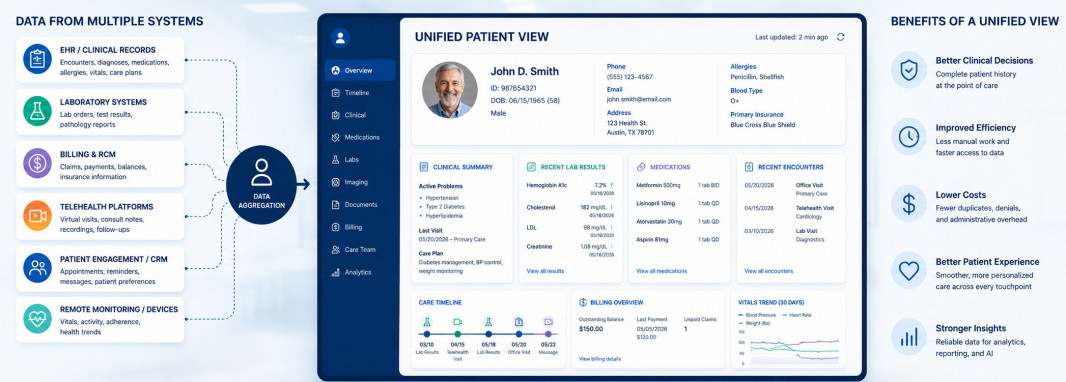
Modern healthcare organizations do not struggle because they lack patient data. In fact, the opposite is true. The average healthcare provider already generates enormous volumes of information across clinical systems, billing platforms, laboratories, telehealth applications, patient communication tools, insurance workflows, and remote monitoring infrastructure. The real problem is fragmentation. Valuable patient information exists, but it remains scattered across disconnected environments that were never designed to function as one coherent ecosystem.
This creates a serious operational problem because healthcare depends on context. A physician making treatment decisions needs more than a single isolated record. Care teams need medication history, laboratory results, prior consultations, specialist notes, recent telehealth interactions, communication history, insurance context, and sometimes longitudinal health data generated outside traditional clinical systems.
This is exactly why organizations invest in medical data aggregation. The objective is not collecting more information. The objective is creating one trusted operational view where fragmented patient data becomes usable, structured, and accessible when needed.
Without that visibility, healthcare organizations operate with incomplete context, and incomplete context creates both operational inefficiency and clinical risk.
Why Fragmented Patient Data Is One of Healthcare’s Biggest Operational Problems
A modern patient journey rarely happens inside one software environment.
A patient may discover a provider through digital outreach managed in a CRM platform. Appointment scheduling may happen through a separate booking system. Clinical documentation lives in the EHR. Laboratory diagnostics are processed elsewhere. Specialist consultations may occur through telehealth software. Billing operates through revenue cycle infrastructure. Insurance verification introduces another data source. Follow-up communication happens in yet another platform. Remote monitoring devices may continuously generate additional health metrics.
Every one of these interactions creates useful information.
The problem is that most healthcare organizations do not see this information as one coherent patient story. They see disconnected fragments.
Clinicians are forced to reconstruct context manually. Administrative teams repeatedly validate information already collected elsewhere. Billing teams reconcile fragmented treatment records. Care coordinators waste time bridging disconnected workflows.
Patients experience this fragmentation directly. They repeat the same information across providers, manually explain care history, complete duplicate paperwork, and often assume the provider is far more technologically connected than reality suggests.
This creates frustration internally and externally.
Fragmentation also creates dangerous blind spots. A physician reviewing a patient without recent diagnostic visibility may make slower or less informed decisions. A telehealth provider working without access to prior treatment history operates with reduced confidence. Administrative staff working with inconsistent identity records may create billing or scheduling errors.
Healthcare does not simply need access to data.
Healthcare needs unified context.
How Medical Data Aggregation Actually Works
Medical data aggregation is often misunderstood as a giant data dump where every system exports information into a single dashboard.
That is a shallow version of the concept.
Effective aggregation is infrastructure architecture.
Rather than replacing every healthcare platform, organizations build an aggregation layer that sits above existing systems and creates a unified operational data model. This layer pulls relevant information from multiple environments, standardizes inconsistent formats, resolves identity conflicts, and creates a structured patient view that can be trusted across workflows.
This matters because healthcare organizations rarely have the appetite for full infrastructure replacement. Enterprise healthcare software is expensive, deeply embedded, operationally sensitive, and politically difficult to replace.
Aggregation creates modernization without demanding immediate architectural destruction.
The original systems continue performing their specialized roles. The EHR remains the clinical documentation environment. Billing continues handling financial workflows. Laboratory systems manage diagnostics. Telehealth platforms deliver virtual care. CRM platforms orchestrate communication.
Aggregation creates visibility across them.
The first major challenge is patient identity resolution.
Before a unified patient view can exist, the organization must reliably determine which records belong to the same individual.
That sounds easier than it actually is.
Patients may exist under slightly different names across systems. Contact details change. Insurance records evolve. Telehealth platforms may generate separate digital identities. CRM systems may rely on email-based registration while clinical systems depend on enterprise patient identifiers.
Without identity resolution, aggregation becomes dangerous because disconnected fragments may be merged incorrectly or remain falsely separate.
That is why serious aggregation environments rely on identity matching logic, duplicate detection, reconciliation workflows, and governance controls.
The second major challenge is data normalization.
Healthcare systems rarely structure information consistently.
Dates may appear in different formats. Medication naming conventions vary. Diagnostic terminology differs between vendors. Some systems rely on structured coding while others depend heavily on free-text human input. Custom vendor-specific fields introduce additional inconsistency.
Raw aggregation alone does not solve this.
Data must be transformed into standardized formats before it becomes operationally useful.
That transformation process is what converts disconnected records into usable intelligence.
The Business and Clinical Value of a Unified Patient View
The most immediate benefit of aggregation is clinical efficiency.
A provider reviewing a patient should not need to open five disconnected systems just to assemble baseline context. Unified visibility dramatically reduces workflow friction by allowing care teams to access relevant information through one operational lens rather than through fragmented manual searching.
This reduces context switching, which directly lowers cognitive load.
That matters because cognitive overload creates mistakes.
Healthcare professionals already operate in high-pressure environments. Forcing clinicians to manually reconstruct fragmented patient history increases fatigue, slows decisions, and introduces avoidable risk.
Aggregation improves care continuity as well.
If a patient moves between physical visits, virtual consultations, diagnostics workflows, and follow-up care, providers gain a coherent longitudinal view instead of disconnected interaction snapshots.
Administrative efficiency improves significantly too.
Scheduling teams work with better patient visibility. Care coordination becomes smoother. Duplicate verification declines. Billing teams operate with cleaner structured context. Patient communication workflows become more intelligent because CRM platforms can act on richer operational insight.
Patients notice the difference quickly.
The experience shifts from fragmented bureaucracy to coordinated care.
Leadership teams benefit just as strongly.
Disconnected systems create fragmented reporting because each platform reflects only part of operational reality. Clinical systems tell one story. Financial platforms tell another. Engagement tools show partial behavioral visibility. Telehealth platforms introduce another reporting silo.
A unified aggregation layer changes this dynamic.
Leadership gains normalized operational visibility across patient activity, care performance, financial efficiency, utilization trends, and service line behavior.
Strategic planning becomes dramatically stronger when decision-makers trust the data.
Artificial intelligence readiness is another major benefit.
AI requires clean, structured, accessible data.
Disconnected infrastructure severely limits AI potential because models operate with incomplete context.
Medical data aggregation creates the operational foundation required for predictive analytics, automation, risk modeling, care intelligence, and decision support systems.
Without aggregated visibility, advanced healthcare innovation remains constrained.
Architecture, Security, and Long-Term Governance
Aggregation does not remove security complexity.
In some ways, it increases it.
A unified patient view creates centralized access to broader information sets, which means authentication, authorization, audit logging, encryption, consent controls, and access governance become critically important.
Poorly designed aggregation creates concentration risk.
The objective is not unrestricted access.
The objective is controlled visibility for the right people, under the right governance model.
Synchronization strategy also matters.
Not every healthcare data flow requires instant real-time updates.
Medication changes, active diagnostics, appointment coordination, and urgent treatment workflows may require near-immediate consistency. Historical analytics, non-critical reporting, or archival workflows may function perfectly well through batch synchronization.
Trying to make every data stream instantaneous creates unnecessary infrastructure complexity and cost.
Practical architecture aligns synchronization strategy with business need.
Aggregation becomes especially powerful for multi-location healthcare organizations.
Hospital groups, specialty networks, telehealth businesses, and expanding provider ecosystems often inherit fragmented infrastructure through growth. Different locations may use different EHRs. Specialty divisions may rely on separate software vendors. Operational workflows diverge over time.
Without aggregation, complexity compounds rapidly.
A unified data layer creates enterprise visibility without requiring immediate forced standardization across every location.
This is often the most realistic modernization path.
Long-term success depends on governance.
Medical data aggregation is not a dashboard project or a one-time integration exercise.
Healthcare infrastructure evolves constantly. Vendors change APIs. New systems enter the environment. Compliance expectations shift. Operational workflows adapt.
Without ownership, monitoring, identity governance, transformation maintenance, and architectural discipline, aggregated environments gradually degrade back into fragmentation.
The strategic value is straightforward.
Healthcare organizations already possess enormous amounts of valuable patient information.
Most simply cannot use it effectively because that information remains trapped inside disconnected operational silos.
Medical data aggregation solves that problem by transforming fragmented records into one coherent patient view that supports better care, cleaner operations, stronger analytics, and long-term digital innovation.
That is what makes it one of the most important infrastructure investments in modern healthcare.