economy and refugees by hiring Ukrainian Software Developers - we donate a lot to charities and volunteer foundations

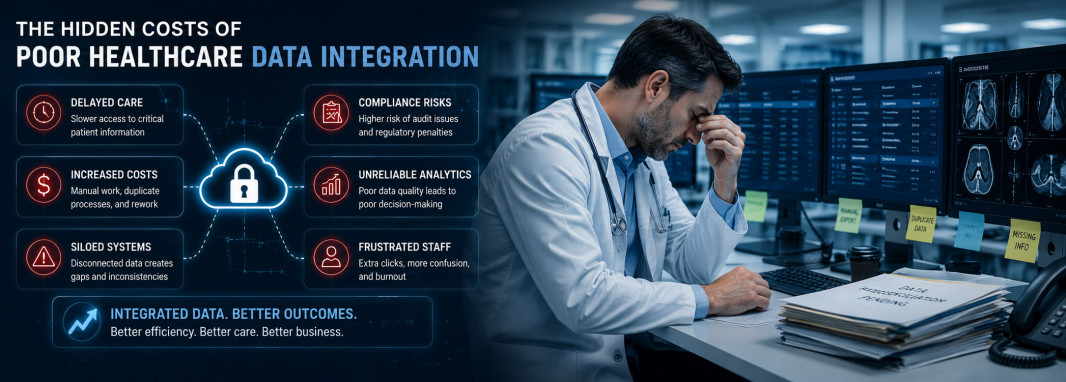
Healthcare organizations often treat data integration as a purely technical infrastructure issue. It gets pushed into IT roadmaps, budget discussions, delayed modernization plans, or long-term transformation conversations that never seem urgent enough to prioritize. On the surface, disconnected systems may look inconvenient rather than strategically dangerous. A clinician opens several platforms to gather patient history, administrative teams manually move records between departments, billing staff reconcile inconsistent data, and spreadsheets quietly become the unofficial glue holding workflows together.
Because these inefficiencies rarely create dramatic system-wide failures, they often become normalized.
That normalization is exactly what makes them expensive.
Healthcare organizations investing in a modern medical system integration solution usually discover the same reality very quickly: poor integration silently drains productivity, revenue, staff capacity, and clinical efficiency every single day.
Labor Costs Grow Faster Than Leadership Realizes
The most immediate financial impact appears in staff productivity, although many organizations fail to measure it properly because the losses are distributed across dozens of small repetitive tasks rather than one obvious broken process.
When healthcare systems do not communicate effectively, employees become the integration layer.
Nurses spend valuable time searching across multiple platforms for patient context instead of focusing on care delivery. Front desk teams repeatedly confirm insurance details or demographic information that already exists somewhere else in the organization. Billing departments manually re-enter treatment data between disconnected systems. Specialists request records that technically exist but remain inaccessible because the software ecosystem is fragmented.
Each delay feels manageable when viewed in isolation.
A few minutes locating information.
Several minutes resolving inconsistencies.
Repeated manual verification that seems routine.
But healthcare operates at scale, and scale turns small inefficiencies into major financial waste.
Across hundreds of employees, thousands of patient interactions, and continuous daily operations, those wasted minutes become a significant operational cost.
A physician forced to navigate fragmented systems sees fewer patients per day. A nurse burdened by administrative friction spends less time delivering care. Administrative teams expand simply because broken workflows require additional human intervention.
Organizations often respond to inefficient architecture by hiring more people instead of fixing the systems creating the inefficiency.
That approach increases payroll while preserving the root problem.
Fragmented Clinical Workflows Create Real Operational Risk
The financial cost is only part of the issue.
Healthcare depends heavily on timely access to accurate information, and fragmented infrastructure directly undermines that requirement.
If medication history is incomplete, treatment decisions become riskier. If diagnostic records are delayed, clinical workflows slow down. If laboratory systems fail to synchronize properly with clinical records, providers may act using outdated or incomplete information.
Healthcare failures rarely happen because of one dramatic technical collapse.
More often, problems emerge through accumulated friction.
Incomplete visibility.
Delayed context.
Human workaround behavior.
A clinician opening four different systems just to assemble a basic patient picture is operating under unnecessary cognitive strain. That strain creates fatigue, and fatigue increases the probability of avoidable mistakes.
Poor interoperability is not merely an efficiency issue.
It directly affects care quality.
Patient Experience Quietly Deteriorates
Patients assume modern healthcare organizations are more connected than they actually are.
From the outside, hospitals, clinics, and digital health providers appear technologically advanced. Patients reasonably expect continuity between departments, specialists, diagnostics providers, billing operations, and follow-up care.
The reality is often very different.
Patients repeatedly complete identical forms.
They answer the same questions multiple times.
They manually explain treatment history between providers.
They request document transfers that should happen automatically.
They encounter inconsistent communication between departments that supposedly belong to the same organization.
This creates frustration very quickly.
From the patient perspective, disconnected systems feel like organizational incompetence rather than technical complexity.
Trust declines when care feels fragmented.
That trust loss creates measurable business consequences through weaker satisfaction scores, reduced retention, damaged referral confidence, and broader reputational decline.
Revenue Leakage Becomes a Structural Problem
Revenue cycle management suffers significantly when healthcare systems remain disconnected.
Billing depends on clean, synchronized, structured information moving consistently across treatment documentation, coding workflows, payer verification, and financial systems.
When that flow breaks, financial friction follows.
Claims get rejected because information is incomplete.
Reimbursements are delayed because documentation does not align.
Manual corrections consume staff time.
Payer disputes increase.
Preventable write-offs accumulate.
Finance departments often focus on resolving these visible symptoms without recognizing that the deeper issue is architectural fragmentation.
Disconnected systems create ongoing revenue leakage that compounds over time.
This becomes especially dangerous because organizations may incorrectly treat claims inefficiency as a finance department problem when the actual root cause sits inside infrastructure design.
Analytics Become Less Trustworthy
Modern healthcare leadership increasingly depends on data for operational planning, staffing decisions, performance monitoring, compliance oversight, forecasting, and strategic investment.
That becomes much harder when different systems produce conflicting operational narratives.
Clinical platforms show one version of activity.
Billing systems show another.
Patient engagement tools reflect only partial behavioral visibility.
Telehealth platforms create yet another reporting silo.
Metrics stop aligning.
Dashboards become unreliable.
Leadership teams spend time debating whose numbers are correct instead of acting confidently on trusted insight.
Without normalized visibility, strategic decision-making becomes slower and less effective.
Poor integration does not simply reduce reporting quality.
It weakens executive decision-making across the organization.
Compliance and Security Costs Expand Quietly
Healthcare compliance already demands significant operational discipline.
Disconnected infrastructure makes that burden heavier.
Regulatory reporting often requires pulling information from multiple systems, validating inconsistencies, reconciling records, and manually reviewing documentation before submission.
What should be a structured reporting workflow becomes expensive operational labor.
Security risk expands in similar ways.
Fragmented organizations often create unofficial workarounds to compensate for poor interoperability. Staff export spreadsheets containing sensitive information. Departments maintain local tracking databases outside governed infrastructure. Files move manually between teams. Credentials become duplicated across multiple disconnected platforms.
These behaviors may feel practical in the moment.
Operationally, they create serious governance risk.
Fragmentation rarely remains neatly contained inside official systems.
It spreads through human workaround behavior.
Disconnected Infrastructure Blocks Innovation
Healthcare leaders increasingly want artificial intelligence, predictive analytics, care automation, patient personalization, operational intelligence, and digital transformation initiatives.
These ambitions depend on structured, accessible, trustworthy data.
Disconnected infrastructure creates the opposite environment.
Data remains fragmented.
Context remains incomplete.
Operational visibility remains inconsistent.
AI pilots may look promising in controlled conditions, but scaling becomes difficult because the foundational architecture is weak.
Organizations often assume innovation failure reflects technology limitations.
In reality, the problem is often data readiness.
Disconnected systems make advanced innovation dramatically harder to operationalize.
The Real Cost Is Bigger Than IT
Healthcare integration projects are often evaluated through one narrow lens: implementation cost.
That framing misses the real business equation.
The comparison is not modernization investment versus doing nothing.
The actual comparison is modernization investment versus continuous hidden operational loss.
Poor healthcare data integration creates drag across staffing, patient experience, finance, compliance, analytics, security, and innovation readiness.
These losses rarely appear as one clean line item in a budget report.
That is exactly why they remain underestimated for so long.
Organizations that solve interoperability do much more than improve technical architecture.
They remove structural inefficiency embedded across the entire business.
In healthcare, disconnected data is not merely a technical inconvenience.
It is an expensive operational liability that compounds every day it remains unresolved.