economy and refugees by hiring Ukrainian Software Developers - we donate a lot to charities and volunteer foundations

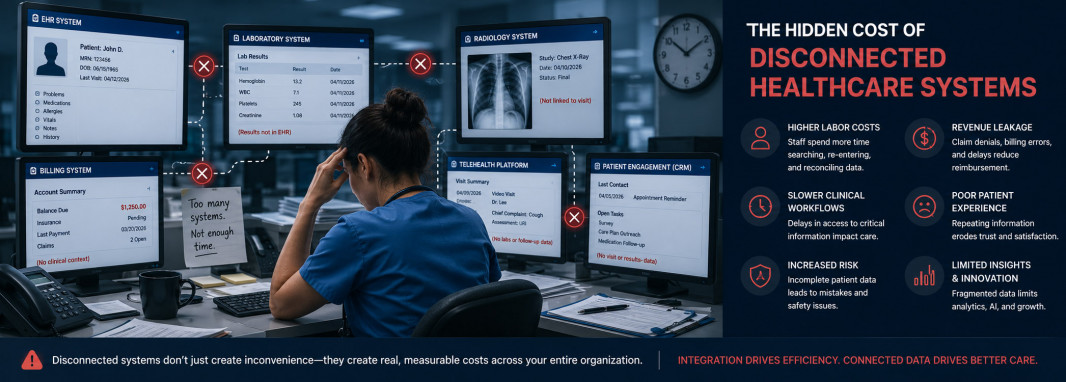
Modern healthcare organizations often believe their biggest technology problem is outdated software. In reality, the bigger issue is fragmentation. Many providers already have modern digital tools, but those tools operate in isolation. The EHR sits in one environment, billing in another, telehealth in another, laboratories in separate diagnostic systems, patient communication inside CRM tools, and analytics often disconnected from all of them. On paper, the organization looks digitally mature. Operationally, it behaves like a collection of disconnected departments held together by human effort.
This is exactly why healthcare organizations increasingly prioritize infrastructure modernization through medical system integration. The problem is not simply that software exists in separate places. The real problem is that disconnected systems create hidden financial and operational drag across the entire business.
Most organizations first notice the issue through workflow inefficiency.
A nurse searches across multiple systems for patient history. A clinician waits for diagnostic visibility. Administrative staff manually reconcile duplicated records. Billing teams correct mismatched treatment data. Front desk employees repeatedly request information already collected elsewhere.
Because these moments appear small individually, leadership often underestimates their cumulative cost.
But healthcare runs at scale.
Five wasted minutes repeated across hundreds of employees and thousands of interactions quickly becomes substantial operational waste.
Organizations often solve these problems by adding labor instead of fixing architecture.
More administrators.
More reconciliation effort.
More coordination roles.
More manual verification.
Disconnected systems quietly increase payroll dependency.
Clinical workflows suffer in more dangerous ways.
Healthcare depends on context.
If treatment history is incomplete, decisions become slower and less reliable. If laboratory results remain trapped in disconnected systems, care pathways delay. If telehealth providers lack recent patient visibility, continuity suffers. If clinicians must manually assemble fragmented information, cognitive load increases.
Healthcare professionals already work under pressure.
Poor infrastructure adds unnecessary operational stress.
This creates higher fatigue and elevated risk of avoidable mistakes.
Patient experience also deteriorates faster than many organizations realize.
Patients assume modern healthcare providers share information internally.
They expect continuity.
Instead, they often repeat forms, explain treatment history multiple times, manually transfer records, or encounter inconsistent communication between departments.
From the patient perspective, disconnected infrastructure feels like organizational incompetence.
Trust declines quickly when coordination appears broken.
Revenue impact becomes equally significant.
Healthcare finance depends heavily on structured, synchronized information. Claims workflows break when coding, treatment documentation, payer eligibility, and billing systems fail to align properly.
This creates rejected claims, reimbursement delays, manual correction work, payer disputes, and preventable write-offs.
Finance teams frequently address the symptoms while the underlying architecture remains untouched.
Disconnected infrastructure creates continuous revenue friction.
Analytics becomes another casualty.
Leadership increasingly depends on operational intelligence for forecasting, staffing decisions, capacity planning, compliance oversight, performance monitoring, and strategic investment.
Disconnected systems produce fragmented truth.
Clinical systems show one story.
Billing shows another.
CRM reflects partial engagement behavior.
Telehealth creates separate reporting.
Without normalized visibility, leadership makes strategic decisions using incomplete context.
Innovation slows for the same reason.
Artificial intelligence, predictive analytics, care automation, operational intelligence, and patient personalization all depend on connected structured data.
Organizations with fragmented infrastructure struggle to move beyond isolated pilots because foundational data remains inconsistent.
Even ambitious leadership teams hit architectural limits.
Why Disconnected Healthcare Infrastructure Gets Worse Over Time
Fragmentation rarely stays static.
It compounds.
Healthcare organizations continuously evolve. New software gets added. Clinics are acquired. Service lines expand. Telehealth platforms are introduced. Vendors change. Departments adopt local workflow tools to solve immediate operational pain.
Each short-term decision can create long-term complexity.
What begins as manageable fragmentation gradually becomes architectural debt.
This is especially common in multi-location provider networks.
One clinic may use one workflow stack.
Another may operate differently.
A newly acquired specialty provider may bring its own systems entirely.
Without strategic integration, organizational growth multiplies fragmentation rather than scaling efficiency.
Security complexity also increases.
Disconnected environments encourage unofficial workarounds.
Staff export spreadsheets.
Teams create shadow tracking databases.
Manual file transfers become normal.
Credentials spread across multiple systems.
Governance becomes harder.
The risk surface expands operationally, not just technically.
The Real Cost Is Strategic, Not Technical
Many organizations still frame disconnected healthcare systems as an IT inconvenience.
That framing dramatically understates the problem.
This is a business infrastructure issue.
Disconnected systems increase labor dependency, slow clinical decision-making, weaken patient experience, reduce financial efficiency, complicate compliance, damage analytics quality, and restrict innovation readiness.
The true comparison is not integration investment versus doing nothing.
The real comparison is modernization versus continuous hidden operational loss.
Healthcare organizations that solve fragmentation do more than improve technical architecture.
They create operational leverage.
Cleaner workflows.
Stronger visibility.
Better patient continuity.
Higher financial efficiency.
Greater readiness for AI-driven healthcare transformation.
Disconnected healthcare systems are expensive precisely because their costs are spread everywhere instead of appearing in one obvious budget line.
That is what makes them so dangerous.